A good tea factory layout moves leaf in one direction, from intake through withering, rolling or CTC, fermentation, drying, sorting and packing, and never lets raw leaf cross paths with made tea. Start from peak-day leaf, size each section from that figure, then add utilities, hygiene zones and room to grow.
Most pages on this topic show a drawing without explaining the reasoning. This guide explains the logic, so you can adapt it to a mini factory, an estate plant or a reorganisation of an existing building.
What a Tea Factory Layout Needs to Achieve
A layout has three jobs: keep the product moving, protect quality, and keep the plant easy to run and expand.
One-Way Flow and No Crossover
Leaf should travel from the receiving end to the packing end without doubling back. A typical layout sketch lists reception, office, lab, withering troughs, CTC cutter, fermentation, drying, sorting, and packing, with staff areas and an emergency exit and assembly point alongside (XYZ Tea Factory Layout Plan). The sequence is the backbone. Everything else is arranged around it.
Three rules follow from one-way flow:
- Place withering on an upper floor or in a well-ventilated loft, so leaf can drop by gravity to the next stage.
- Keep raw leaf, wet processing, and dry made tea in separate zones.
- Give people and trolleys their own routes, so they do not cut through finished-tea areas.
Capacity as the Starting Point
Every dimension comes from capacity. Use two numbers:
- Peak-day green leaf. Trough design is based on about 30 kg per m² for the peak crop expected in a single day (UPASI, Tea Manufacturing). The page is old, so check it against current practice for your cultivar and climate.
- Leaf-to-made-tea ratio. About 5 kg of green leaf makes 1 kg of made tea (CAG, From leaf to cup).
Design for the peak day, not the yearly average. A plant sized for average leaf will choke in the flush.
The Standard Flow, Section by Section
The steps for CTC are withering, green leaf shifting, reconditioning, rolling, fermentation, drying, grading and sorting, and packing (UPASI, CTC). Here is what each means for the floor plan.
Leaf Intake and Weighing
Put the receiving bay on the approach road, with space for trucks to turn and queue. Weighing, quality checks, and a short holding area belong here. Keep it close to the withering loft access so leaf is not carried far.
Withering
Withering is the largest single area in most factories. A typical trough runs about 100 ft by 12 ft and holds about 2,000 kg per batch, with withering taking 8 to 12 hours (CAG). The target is moisture of around 70%, and trough blowers are typically about 5 HP with 50,000 to 75,000 CFM (CAG on Medium).
Leave clear aisles for leaf loading and turning, and plan air inlets and fan rooms early. Conditions here shape the cup, which is why we cover them in how withering conditions influence tea quality. For continuous withering, allow for a longer, narrower footprint.
Rolling or CTC
In CTC, rolling uses four or five machines in tandem, each with two contra-rotating toothed rollers of 20.3 cm (8 in) (UPASI, CTC). Sources vary between three and five machines depending on grade, so treat it as a range and confirm the count with your machinery supplier. Place the line directly below the withering loft and leave space on both sides for maintenance and roller changes.
Consistent feed matters here, as explained in why consistent feeding matters in tea processing. Orthodox lines use rolling tables and roll breakers instead, with a different footprint.
Fermentation
In South Indian CTC factories, dhool passes through a rotating drum with conditioned air for 60 to 90 minutes (UPASI, CTC). Other plants use fermenting beds or tables. Either way, keep this zone cool, humid, and clean, and place it between the cutters and the dryer so dhool travels a short, direct path.
Drying
Most factories use Endless Chain Pressure (ECP) dryers (CAG). Drying brings moisture down from 55 to 60% to 2 to 3% (TNAU Agritech). The dryer needs hot air from a heater and a boiler or furnace nearby, so locate it on an outer wall with short ducting and a clear route for fuel and ash. Hot, dry areas should be separated from the humid fermentation room. For the energy trade-offs, see balancing efficiency, throughput and quality in tea drying.
Cooling, Sorting and Grading
Made tea must cool before it is sorted. The sorting section typically holds 10 to 15 motors of 1 to 3 HP each (CAG), which means noise, dust, and power load. Give it a dedicated room with dust extraction and good lighting. Sorting machines, from vibrating screens to colour sorters, come in at this point.
Packing and Storage
Packing and finished-goods storage sit at the end of the line and should be the cleanest, driest rooms in the building. Plan for:
- A blending area with space for bulk bins.
- Bag handling and a conveyor route to the dispatch dock.
- A finished-goods store away from the boiler, fuel, and wet processing.
- A dispatch bay that does not share a road with leaf intake, if the site allows.
Sizing the Factory: A Worked Example
Take a mini factory. The Tea Board defines micro factories as handling up to 200 kg a day and mini factories up to 500 kg a day (Bihar Model DPR). Another source gives micro units as 22.5 to 225 kg of made tea a day and mini units as 450 to 500 kg (Teamech India). The two define units differently, so check whether a figure refers to green leaf or made tea before you compare.
The same vendor page gives an indicative 500 kg/day mini factory, run 200 days a year on one shift, needing a 4,000 sq ft building, 75 kW of power and 200 litres of water a day. Treat these as a starting point, not a design.
Now work the trough area from the 30 kg per m² rule:
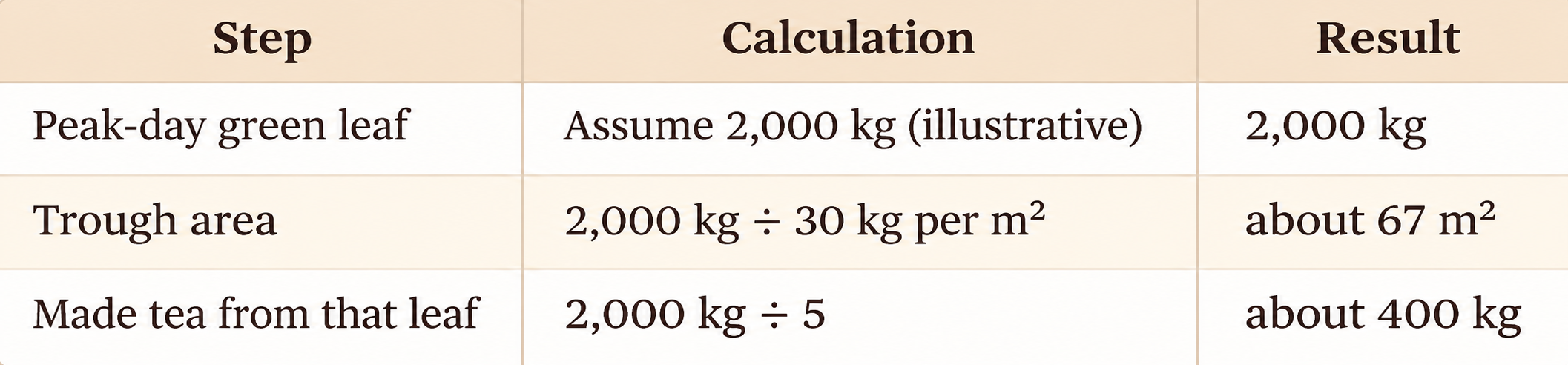
The 2,000 kg input is an assumption for illustration, not a recommendation. Replace it with your own peak-day figure. One typical trough of 100 ft by 12 ft is about 111 m² and holds around 2,000 kg per batch, so real troughs often carry a safety margin over the 30 kg per m² rule. For an estate, repeat the calculation at the larger scale and split withering into several troughs so one can be loaded while another is unloaded.
To see how this feeds the machinery and utility budget, read the cost of setting up a tea factory.
Want your trough area, machine count and utility load checked against your own peak-day leaf? Share your capacity and request a quote for your capacity from our engineers.
How Layout Changes by Tea Type
The section order changes with the tea you make.
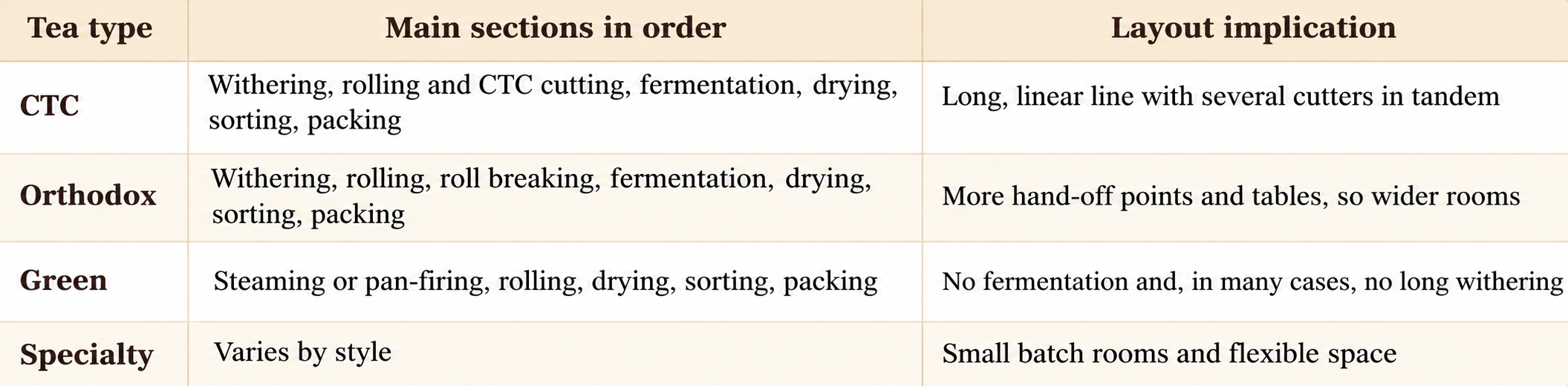
CTC dominates much of the Indian market, and one source puts it above 85%, though that figure is undated and unsourced, so verify it before relying on it. Even so, do not assume CTC. A green tea plant skips long withering and fermentation, so it needs less floor space ahead of the dryer but more care in the roasting and cooling zone.
For CTC planning, see our CTC tea machinery. For rolling tables, roasters and dryers for other styles, see orthodox and green tea machinery. Small growers can look at mini tea processing lines, which compress the same flow into a smaller footprint.
Utilities and Support Areas
Utilities decide where machines can sit, so settle them before you fix the plan.
Heat Source, Power and Ducting
The heat source drives the drying layout. A Tripura factory processing 500,000 kg of green leaf a year uses 50,000 kWh and 140,000 kg of coal (CAG). That shows how fuel dominates energy use. Plan for:
- A boiler or furnace room on the outer wall, close to the dryer.
- Fuel storage and an ash route that do not cross the leaf path.
- Short, insulated ducting for hot air.
- A power room with space to add motors later.
If you are choosing between fuels, such as coal, biomass or gas, decide before you finalise the boiler room, because storage and feed needs differ. Boilers, steam fittings and electricals can be planned together under turnkey solutions.
Water, Effluent, Lab, Offices and Staff Facilities
Water use is modest in tea processing, with about 200 litres a day for the indicative 500 kg/day factory above, but you still need a clean supply for washrooms, cleaning and the boiler. Allow for:
- A drain and effluent route for washing areas.
- A tasting lab with controlled light, near the sorting room but away from noise.
- An office with a view of the weighing bay.
- Canteen and restrooms, plus an emergency exit and assembly point.
Hygiene and Safety Zoning
Divide the plant into three zones:
- Raw zone: intake, weighing, and withering. Dust and leaf debris are expected.
- Process zone: rolling, fermentation, and drying. Humid and warm.
- Clean zone: sorting, blending, packing,g and storage. Dry, controlled and easy to wash down.
Move from raw to clean in one direction only. Use separate entrances or changing points for the clean zone, and keep trolleys for raw leaf out of it. For safety, add guarding around rollers, fire separation between the boiler room and the leaf areas, clear exit paths, and enough lighting around machines.
Planning for Expansion and Automation
Leave the end walls of the line free so sections can lengthen. Position the boiler and power room so they can serve a second line. Run conduits and ducts with spare capacity.
Automation also needs space and cabling: feeders, discharge controls, dryer controls, and monitoring. If you are deciding where to start, read what to automate first in a tea factory, and how to identify the real bottleneck before adding capacity.
Common Layout Mistakes
- Sizing for average leaf rather than peak-day leaf.
- Placing the dryer far from the heat source, which adds duct losses.
- Crossing raw leaf routes with the path of made tea.
- Forgetting maintenance clearance around rollers and cutters.
- Putting the store beside the boiler or fuel yard.
- Leaving no space for a second line or extra troughs.
- Skipping a drainage plan until the floor is poured.
Layout Planning Checklist
- State peak-day green leaf and the tea types to be made.
- Calculate trough area and number of troughs.
- Fix the flow direction and draw the one-way route.
- Choose the heat source and place the boiler and dryer together.
- List machine counts and ask suppliers for exact footprints.
- Total the power load and water demand.
- Define raw, process, and clean zones.
- Plan drainage, fuel storage, and ash handling.
- Place the lab, office, staff facilities, and exits.
- Reserve space for expansion and automation.
Final Thoughts
A tea factory layout is a flow design problem first and a drawing second. Fix capacity, keep the leaf moving one way, group heat and drying together, and zone the plant by cleanliness. Confirm machine footprints and utility loads with your equipment supplier before construction begins.
Frequently asked questions
1. What are the sections of a tea factory, in order?
For CTC, the order is leaf intake, withering, green leaf shifting, reconditioning, rolling, fermentation, drying, grading and sorting, then packing. Orthodox adds roll breaking and uses rolling tables. Green tea skips fermentation and often has long withering.
2. How big should withering troughs be?
One design basis is about 30 kg of leaf per m² for the peak crop expected in a single day. A typical trough is around 100 ft by 12 ft and holds about 2,000 kg per batch. Check the figures against current practice and your climate.
3. How much space does a mini tea factory need?
One vendor example for a 500 kg/day mini factory, running 200 days a year on one shift, gives a 4,000 sq ft building, 75 kW of power and 200 litres of water a day. Treat it as indicative and confirm with your own design.
5. Where should the dryer and boiler go?
Place them together on an outer wall, after fermentation in the flow. This keeps hot air ducting short and lets fuel and ash move without crossing the leaf path.
6. Can green leaf and made tea share the same area?
They should not. Use raw, process, and clean zones, with one-way movement from raw to clean, and separate trolleys and entry points for the packing and storage area.