Automation is becoming an increasingly important part of modern tea manufacturing. As factories work to improve production consistency, reduce avoidable losses, and manage growing operational demands, automated monitoring and control systems are often considered a natural next step.
However, automation is not simply about replacing manual work or installing advanced controls across every section of a factory. A poorly prioritised automation project can add complexity without addressing the problem that affects production most.
The more important question is: What should a tea factory automate first?
The answer depends on the factory’s process conditions, existing equipment, production challenges, and long-term objectives. In some facilities, the right starting point may be withering control. In others, fermentation, drying, material feeding, or process monitoring may offer greater value.
What Does Automation Actually Mean in a Tea Factory?
In a tea processing factory, automation can range from a simple monitoring system to the coordinated control of several connected processing stages. It does not always require a completely new production line or the replacement of every existing machine.
At its most basic level, automation helps a factory measure and monitor what is happening. Sensors and control systems can track operating conditions such as temperature, relative humidity, feed rate, belt speed, residence time, and equipment status. This gives production teams better visibility into the process and reduces dependence on manual observation alone.
The next level involves automatic adjustment. Instead of relying entirely on operators to regulate a process, the system can respond to changing conditions by adjusting parameters such as airflow, temperature, feed rate, or conveyor speed within defined operating limits.
Automation can also support coordination between machines. Feeding, processing, and discharge systems can be linked so that material moves more consistently between stages, reducing unnecessary waiting, overloading, or underfeeding.
In practical terms, tea factory automation may include:
- Process monitoring and data logging
- Temperature and humidity control
- Automated feeding and discharge
- Conveyor-speed and residence-time regulation
- Equipment alarms, sequencing and line integration
Automation should be selected according to the process problem it is intended to solve. A factory that struggles with inconsistent fermentation conditions may need a different solution from one experiencing unstable dryer feeding or frequent manual adjustments.
The goal is not to automate for its own sake. It is to make the process more measurable, controllable, and consistent.
Why Automating Everything at Once Is Not Always the Right Approach
When factories begin exploring automation, it can be tempting to think about a complete, fully automated processing line. Although integrated automation can offer long-term advantages, implementing everything at once is not always the most practical or cost-effective starting point.
A tea factory may already have functioning machinery, experienced operators, and established production practices. Replacing or connecting every section simultaneously can introduce significant investment requirements, installation challenges, and operational disruption. It may also create compatibility issues between new control systems and existing equipment.
Automating a process is not the factory’s main constraint. A factory may invest in automated material handling while continuing to experience inconsistent withering conditions. Another may install advanced monitoring on a dryer even though the actual production loss is caused by unstable feed from an upstream section. In both cases, automation may improve one activity without addressing the issue that limits overall performance.
A phased approach is often more practical. The factory can begin with one clearly defined problem, establish a measurable baseline, implement a targeted improvement, and assess the results before expanding to other sections.
Integrated automation can still be valuable when a new processing line is being developed, or several existing sections need to work together.
The objective is not to automate the greatest number of machines. It is to automate the processes where improved control and coordination can create the greatest measurable benefit.
What Should You Evaluate Before Choosing a Starting Point?
The right automation project begins with understanding the factory’s current operating challenges. Before selecting a technology, production teams should identify where the real constraint lies.
1. Identify where variability is affecting production
If temperature, humidity, feed rate, or residence time fluctuates significantly, the resulting variation may affect production performance and tea quality.
2. Look at manual intervention and operator dependency
Manual operation is not automatically a problem. Experienced operators remain important in tea manufacturing, particularly when judgement and process knowledge are required.
The issue arises when operators must repeatedly perform tasks that could be monitored or controlled more consistently through a suitable system. Frequent manual temperature adjustments, repeated feed-rate corrections, or continuous observation of several process points may indicate an opportunity for automation.
3. Consider energy and resource consumption
Energy-intensive sections deserve careful evaluation, particularly where process control can influence thermal performance or reduce unnecessary operation.
Research identifies drying as a major energy-consuming stage in tea processing, making it a relevant area to examine when assessing automation opportunities.
However, energy savings should be measured under actual operating conditions rather than assumed simply because a system is automated.
4. Assess whether the process can be measured and improved
Automation is easier to evaluate when the factory can establish a clear baseline and track measurable results.
5. Check compatibility with the existing line
Finally, consider whether the proposed automation can work with the factory’s existing machinery, electrical systems, controls, and operating practices. A technically advanced solution may not be suitable if it cannot be integrated reliably or maintained by the available technical team.
The best starting point is therefore the process where the operational need is clear, the improvement can be measured, and the proposed automation can be implemented realistically.
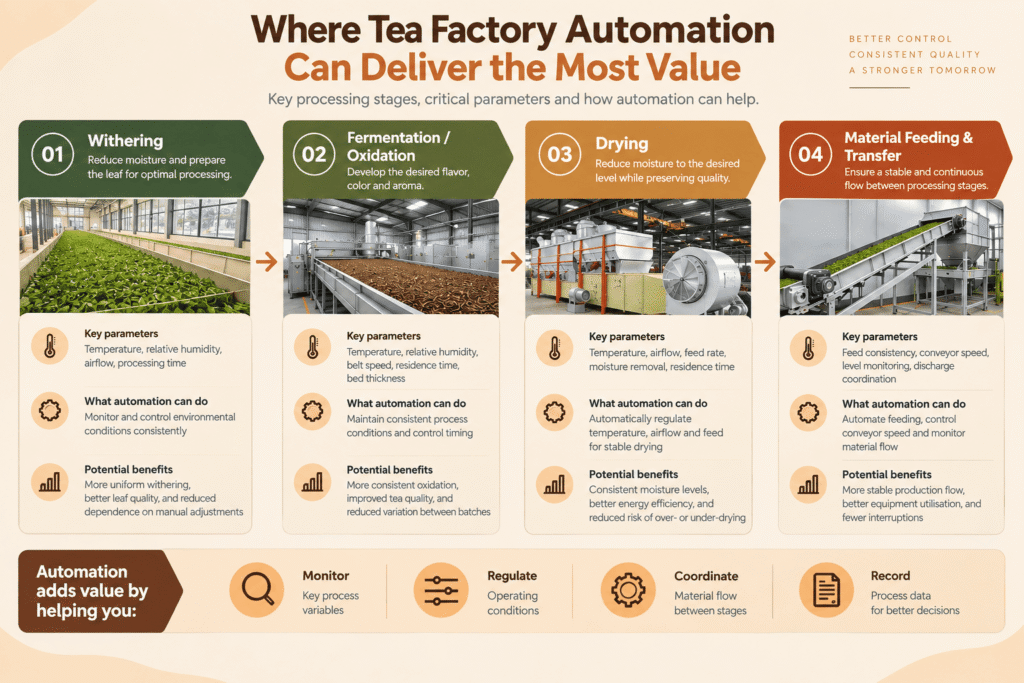
Where Tea Factory Automation Can Deliver the Most Value
Once the factory’s main operational challenges are understood, several processing areas may present opportunities for automation.
Withering: Managing Changing Process Conditions
Withering can be an important area to evaluate when factories experience inconsistent environmental conditions, uneven airflow, or variations in feed and discharge. Since the process is influenced by factors such as temperature, relative humidity, airflow, and processing time, manual monitoring alone may make it difficult to maintain uniform conditions across the system.
Automation can support withering by monitoring environmental parameters, regulating airflow, controlling operating conditions, and coordinating material movement. Continuous withering systems, for example, can be designed to provide more consistent process management than disconnected manual operations.
Fermentation and Oxidation: Improving Control and Repeatability
Fermentation, or oxidation in tea processing, is another area where automation may offer significant value, particularly in CTC tea production. The process is sensitive to conditions such as temperature, relative humidity, bed thickness, airflow, belt speed, and residence time.
When these parameters are managed manually, variations in operating conditions may affect process repeatability. Automation can help production teams monitor key variables and regulate the process within defined limits. It can also support better coordination between fermentation equipment and the stages before and after it.
Drying: Controlling Temperature, Feed and Residence Time
Drying is often a significant area for evaluation because it directly influences final moisture content, product stability, quality consistency, and energy consumption. Tea-drying systems must manage several variables simultaneously, including temperature, airflow, feed rate, moisture removal, and residence time.
Automation can help regulate dryer temperatures, monitor operating conditions, coordinate feeding, and provide alerts when parameters move outside the desired range. Data logging can also help production teams identify recurring issues and compare actual performance against operating targets.
Because drying is an energy-intensive stage in tea processing, improved control may create opportunities to reduce avoidable energy losses. Nevertheless, energy savings should be verified through actual operating data rather than assumed solely from installing an automated system.
Material Feeding and Transfer: Creating a More Stable Process Flow
Automation does not always need to begin with the most technically complex machine. In some factories, material feeding and transfer may be the more practical starting point.
Inconsistent feeding can affect the performance of downstream equipment. Overfeeding may create loading issues, while underfeeding can reduce utilisation and interrupt production flow. Automated feeders, conveyor-speed regulation, level monitoring, and coordinated discharge systems can help create a more stable movement of material between processing stages.
This type of automation can also provide a foundation for future integration. Once feeding, transfer, and equipment status are connected, additional process controls can be introduced more systematically.
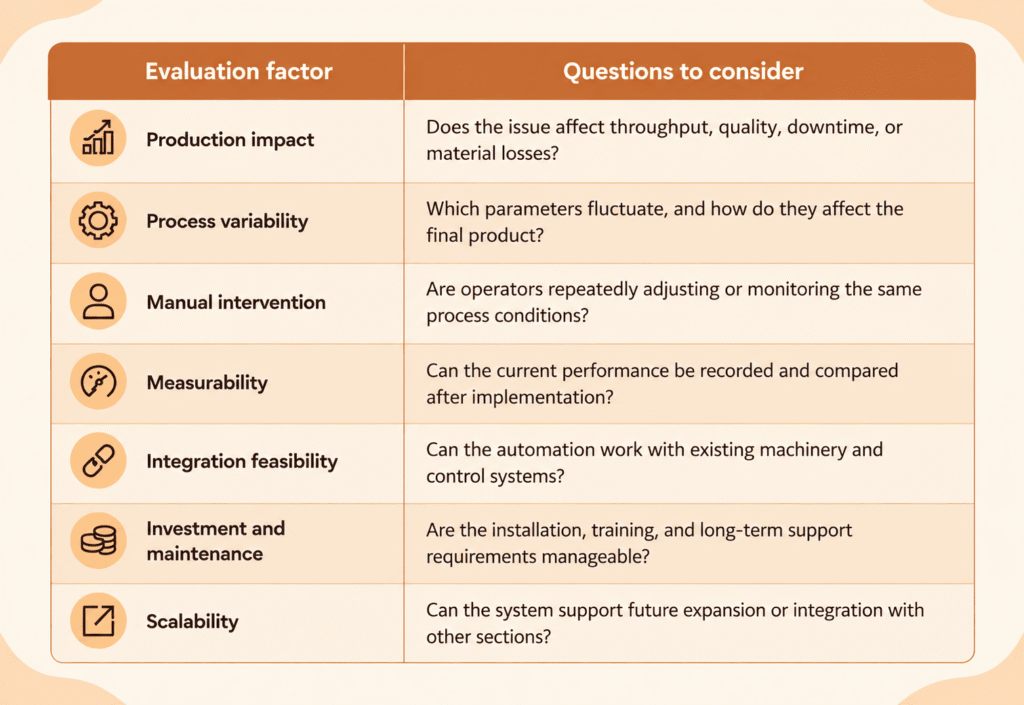
A Practical Starting Framework
Once a factory has identified potential automation opportunities, the next step is to compare them using a structured evaluation rather than selecting a project based only on equipment availability or technological appeal.
A simple assessment can help production and management teams understand which opportunity should be explored first.
Start with a Clearly Defined Problem
Begin by defining the operational problem in specific terms. Improving temperature consistency, reducing feed fluctuations, or minimising manual adjustments provides a more useful automation objective than simply ‘modernising the factory’.
Establish a Baseline
Before implementing automation, document how the process currently performs. Depending on the application, this may include production rate, temperature variation, moisture content, residence time, downtime, energy consumption, or operator interventions. Without a baseline, it becomes difficult to determine whether the automation project has delivered a meaningful improvement.
Select the Appropriate Level of Automation
Not every process requires a fully automated system. Some factories may benefit from monitoring and data logging first, while others may need automatic control or integration between multiple machines.
The appropriate level may include:
- Monitoring: Collecting and displaying process information.
- Alerting: Notifying operators when conditions move outside defined limits.
- Automatic control: Adjusting selected parameters within established operating ranges.
- Line integration: Coordinating several machines or process stages.
- Data-based optimisation: Using historical information to identify patterns and improve operating decisions.
This staged approach allows the factory to match the complexity of the system with its actual requirements.
Plan for People, Maintenance and Training
Automation also requires trained operators, maintenance support and appropriate documentation. Sensors, control systems, drives and communication equipment need ongoing inspection and technical support, so implementation planning should include training, maintenance and spare-part requirements, not just installation.
Automation Should Be Planned Around the Whole Processing Line
Although a factory may begin by automating one specific process, the long-term objective should be to improve the coordination of the complete processing line. Tea manufacturing involves a sequence of connected stages, and the performance of one section can influence the operation of the next.
Connect Critical Process Stages: Where appropriate, automation systems can connect equipment through common control interfaces, sensors, drives, communication networks, and supervisory systems. This allows production teams to monitor the status of multiple machines and coordinate their operation more effectively.
Use Data to Understand the Line: Operational data such as temperature trends, belt speeds, equipment status, alarms, and downtime can help identify recurring problems and support better production and maintenance decisions. However, collecting data alone does not improve performance. The factory must define which information matters, who will review it, and how the findings will be used.
Build in Stages: A practical automation roadmap may begin with one priority process and gradually extend to related sections. For example, a factory could first introduce monitoring and control in a critical process, then connect its feeding and discharge systems, and later integrate additional stages through a centralised interface.
T&I Global has also documented an integrated CTC processing project combining automated withering, CFM, drying, and other connected processing stages.
This approach allows the factory to learn from each implementation while reducing unnecessary disruption. It also helps ensure that future automation investments are compatible with the systems already in place.
Start With the Process, Not the Technology
Tea factory automation should begin with a clearly defined production need, not simply with the introduction of new technology. The right starting point depends on where variability, manual intervention, inefficient material flow, or limited process visibility is affecting the factory.
Withering, fermentation, drying, and material handling can all present opportunities for automation, but their relevance will differ from one factory to another. Establishing a baseline, defining measurable objectives, and assessing compatibility with existing equipment can help manufacturers determine where automation can create meaningful value.
Automation is most effective when it works alongside sound process practices, reliable machinery, trained personnel, and appropriate maintenance. It should make the process more measurable, controllable, and connected, not simply more automated.
For tea manufacturers planning their next step, T&I Global’s automation solutions cover applications across areas such as withering, fermentation, and drying. The appropriate solution should be determined by the factory’s existing process, equipment, and specific production requirements.
The question is not how much of a tea factory can be automated, but where better control, monitoring, and coordination can make a measurable difference.
Frequently Asked Questions (FAQs)
1. Which process should a tea factory automate first?
There is no universal starting point for every tea factory. The first process should be selected based on the factory’s main operational challenge, such as inconsistent process conditions, excessive manual intervention, unstable feeding, energy consumption, or poor coordination between machines.
2. Can existing tea-processing machinery be automated?
In many cases, existing machinery can be upgraded or integrated with suitable automation systems. However, feasibility depends on the machine’s condition, electrical controls, sensors, drives, communication systems, and compatibility with the proposed automation technology. A technical assessment should be completed before implementation.
3. How can automation improve tea-processing consistency?
Automation can help maintain process parameters within defined operating limits. Depending on the application, this may include regulating temperature, relative humidity, feed rate, belt speed, airflow, or residence time. Consistency improves when these variables are monitored and controlled more reliably.
4. Does tea factory automation reduce manpower requirements?
Automation can reduce repetitive manual monitoring, adjustments, and material-handling activities. However, it does not eliminate the need for skilled personnel. Operators and maintenance teams are still required to supervise systems, interpret data, handle exceptions, and maintain equipment.
5. Can automation help reduce energy consumption in tea factories?
Automation may support better energy management by improving temperature control, feed consistency, operating schedules, and equipment coordination. However, actual energy savings depend on the existing system, operating conditions, equipment efficiency, and how the automation is used. Results should be verified through measured data.