The cost of setting up a tea factory in India depends mainly on capacity, tea type, and how much automation you buy. One NIIR specialty tea guide puts a small unit making 150 to 200 kg of finished tea a day at about ₹22 lakh, and a mid-scale unit at 400 kg a day at ₹40 to 45 lakh, both excluding land. These are indicative figures, not quotes. This guide gives you a budget you can take to a bank or the Tea Board: machinery by tea type, what the building and utilities add, the running costs that follow, and the subsidy rules as set out in the 2024 Tea Board letter. Every figure below notes its source and date so you can check it before you commit.
Cost of setting up a tea factory at each capacity
Capacity moves the budget more than any other single factor. The table lists the ranges found in the sources reviewed. They come from different scopes, so compare rows only with rows of the same type.
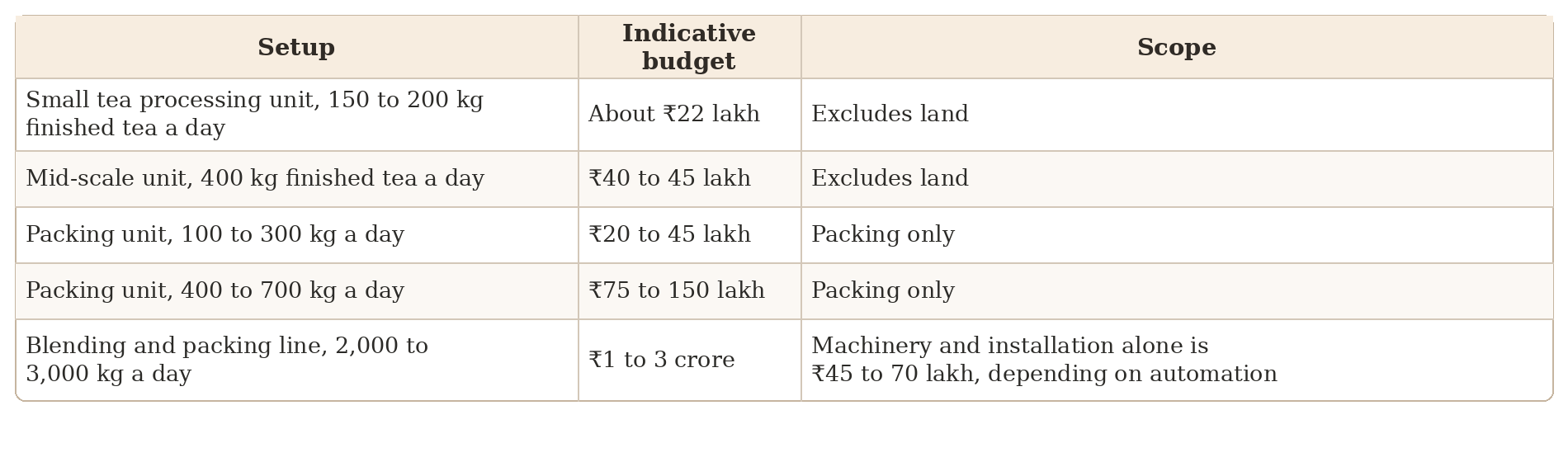
Do not add the rows together. A packing line for a bought-leaf plant is a different project from a full factory with withering, rolling, and drying.
Micro and mini units
The Tea Board’s model project report defines a micro factory as up to 200 kg a day and a mini factory as up to 500 kg a day, as set out in the Bihar model DPR. That document dates from the 2000s, so confirm the thresholds with the Tea Board before you use them in a loan file. On these definitions, the 150 to 200 kg unit sits in the micro band, and the 400 kg unit sits in the mini band.
Two decisions shape the number more than the capacity label does. The first is whether you process your own leaf or buy it in. The second is whether you buy new or used machinery. The table below sets out the trade-off.

A bought-leaf unit usually needs more working capital in its first months, because leaf is paid for before tea is sold.
Packing and blending lines
Packing-only units cost less but still need careful sizing. The NIIR packing project report page gives ₹20 to 45 lakh for a 100 to 300 kg a day packing unit and ₹75 to 150 lakh for a 400 to 700 kg a day unit, described as indicative. The NIIR blending and packing guide puts a 2,000 to 3,000 kg a day line at ₹1 to 3 crore, with machinery and installation at ₹45 to 70 lakh depending on automation. The guide does not itemise the rest of that total, so ask any supplier for the split before you compare quotes.
Automation is the main lever inside that gap. Tea factory automation: what should you automate first explains which steps to automate first, and the blending and packing range covers the packing side.
What the budget covers
Split the budget into five blocks: machinery, building and civil works, utilities, land and working capital. Keep farm costs out of the factory line. Many public templates fold planting and land into the factory total, which inflates the figure and makes it hard to compare with machinery quotes.
Machinery by tea type
Each tea type needs its own machine list, so price each line separately.
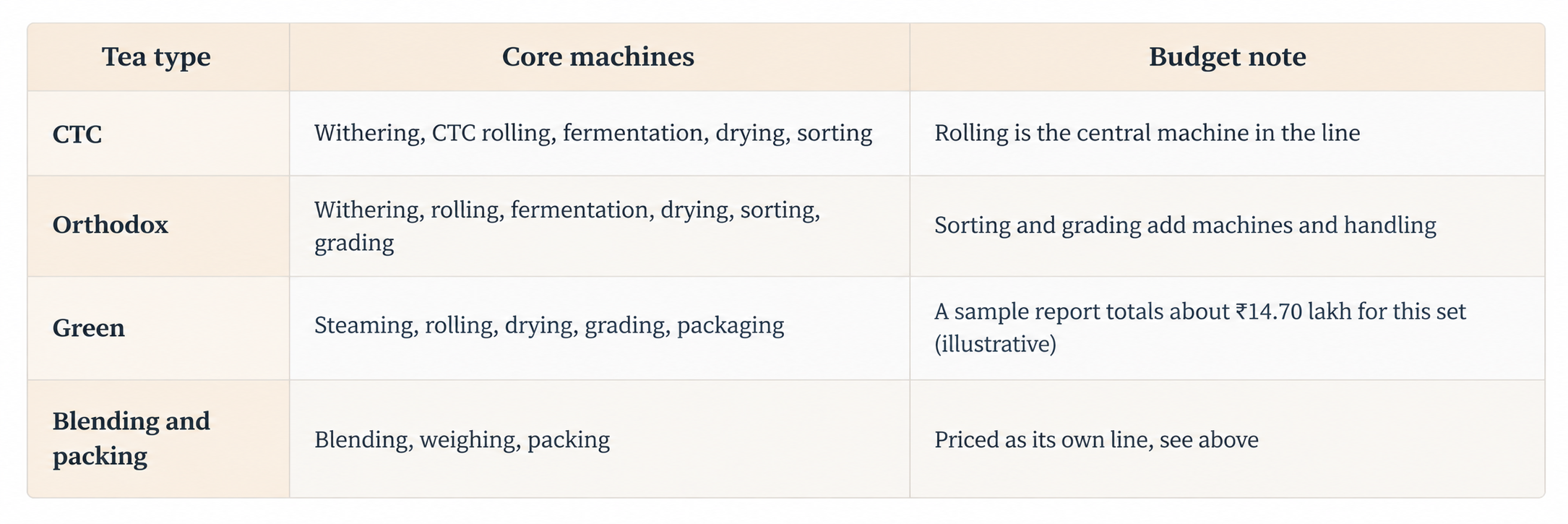
For CTC, a CTC machine listing describes two contra-rotating toothed rollers of 8 inches (20.3 cm) diameter. Ask every supplier to state roller size, drive, and throughput in writing, so quotes can be compared on the same basis.
For green tea, a sample small-scale green tea project report lists a steamer, roller, dryer, grading machine and packaging machine at ₹14.70 lakh in total. Treat that as a template only. The report has a line-item mismatch, so do not copy its figures into a loan application. For orthodox lines, the orthodox and green tea machinery range shows the machine functions in one place.
T&I Global has manufactured tea machinery since 1949 and supplies CTC, orthodox, green and blending equipment. Its catalogue is a useful guide to machine functions, but none of the public sources reviewed here list its prices, so request a quote for your own capacity.
Withering, sorting, drying and packing
Drying usually sets the fuel and power load, so size it with care. One small-unit dryer on the market has seven trays holding 20 kg in total, aimed at small orthodox and green units. That shows how small a single dryer can be, and why dryer capacity must match rolling output. If the dryer is smaller than the rolling line, leaf waits between stages.
Sorting machines are optional for some buyers and essential for others. Decide from your grade mix and the specifications of the buyers you plan to supply. For the energy trade-offs in drying, read tea drying: how to balance energy efficiency, throughput and tea quality.
Building, civil works and generator room
The building is the least standardised line in the budget, and public sources give few usable figures for it. The Bihar model DPR refers to DG sets and grid supply, but its figures are old. Plan the building around three items: a process floor sized to the machine layout, a generator room with fuel storage, and a power connection that matches the connected load.
Civil works also carry subsidy weight, so record them as separate lines with invoices. A combined “building” line makes it harder to show what was spent on eligible items.
Utilities: power, water, fuel and effluent
Public sources do not give a usable power or water table for Indian factories. The one utility figure in the sources reviewed is monthly. The NIIR guide puts utilities and fuel at about ₹0.4 lakh a month for a 150 kg a day unit. Treat that as a running-cost reference, not a full utilities budget.
To build your own utilities figure, ask the machinery supplier for a connected load estimate, check your water source against the process needs, and get a written plan for effluent from the local authority. Fuel for dryers is a running cost that depends on your drying method, so price it from your own consumption tests rather than from a generic table.
Land
Land is excluded from every Indian figure in this article. Price it on its own row. Land costs vary widely between states and districts, so no single figure here would be reliable.
Operating cost and working capital
Green leaf and auction prices
Green leaf is the highest running cost for a bought-leaf unit. The NIIR guide reports that small Upper Assam growers sell green leaf to bought-leaf factories at ₹17 to 25 per kg. Use that as a test range against local quotes, not as a fixed price.
Made-tea prices move the other side of the account. The NIIR packing project report page cites Tea Board data showing an all-India average auction price of ₹215.93 per kg for May 2026, against ₹188.64 per kg for May 2025, the latter provisional. An auction average is a market signal, not your selling price, because grade and quality decide what a lot fetches.
Labour, packaging and logistics
For a 150 kg a day unit, the NIIR guide gives these monthly figures: raw leaf ₹2.8 lakh, labour ₹1.2 lakh, packaging and logistics ₹0.8 lakh, and utilities and fuel ₹0.4 lakh. Added together, that is ₹5.2 lakh a month. Labour is the line that automation most directly targets. The automation range shows where automation can reduce hand work, and the cost of each step should be weighed against the labour it saves.
Working capital
Working capital is the cash you need before sales come in. Take your monthly operating cost, multiply it by the number of months you expect to wait for payment, and add a buffer. At the 150 kg a day rate above, three months of running costs comes to about ₹15.6 lakh before any buffer. That is an illustration of the method, not a benchmark for your plant.
Licences, registration and subsidies
Tea Board registration and factory licence
Start with the Tea Board. One licence-service website says a manufacturing unit or mini tea factory licence is valid for five years and renewable. That site has low authority, so confirm validity, fees, and documents with the Tea Board before you plan around them. Ask your state food and business regulators which approvals apply to your product. The sources reviewed did not give verified FSSAI timelines or fees, so treat any timeline you see as provisional.
Current subsidy rules
A 2024 Tea Board letter to stakeholders offers financial assistance of 40% of actual machinery and civil works cost for new mini tea units set up by self-help groups, farmer producer organisations or farmer producer companies. The ceiling is ₹33 lakh per factory, excluding land.
As an illustration only, if eligible machinery and civil works came to ₹22 lakh, 40% would be ₹8.8 lakh, which is under the ceiling. Your eligible base will depend on what the scheme counts, so confirm it before you plan.
Older documents describe a different rule: 25% of plant and machinery cost. The sources conflict, so date every figure you use and check the latest letter with the Tea Board before you apply.
Why used machinery is excluded
The 2024 letter states that assistance is not given for used machinery. Price new equipment, with a written warranty and commissioning support, into the budget. A used line can lower the capital cost on paper, but it removes the subsidy from the calculation and may bring repair time that delays the first run.
Sample budget table
Use this template to build your own budget. Fill each line from a written quote for your capacity and tea type, and keep land on its own row.
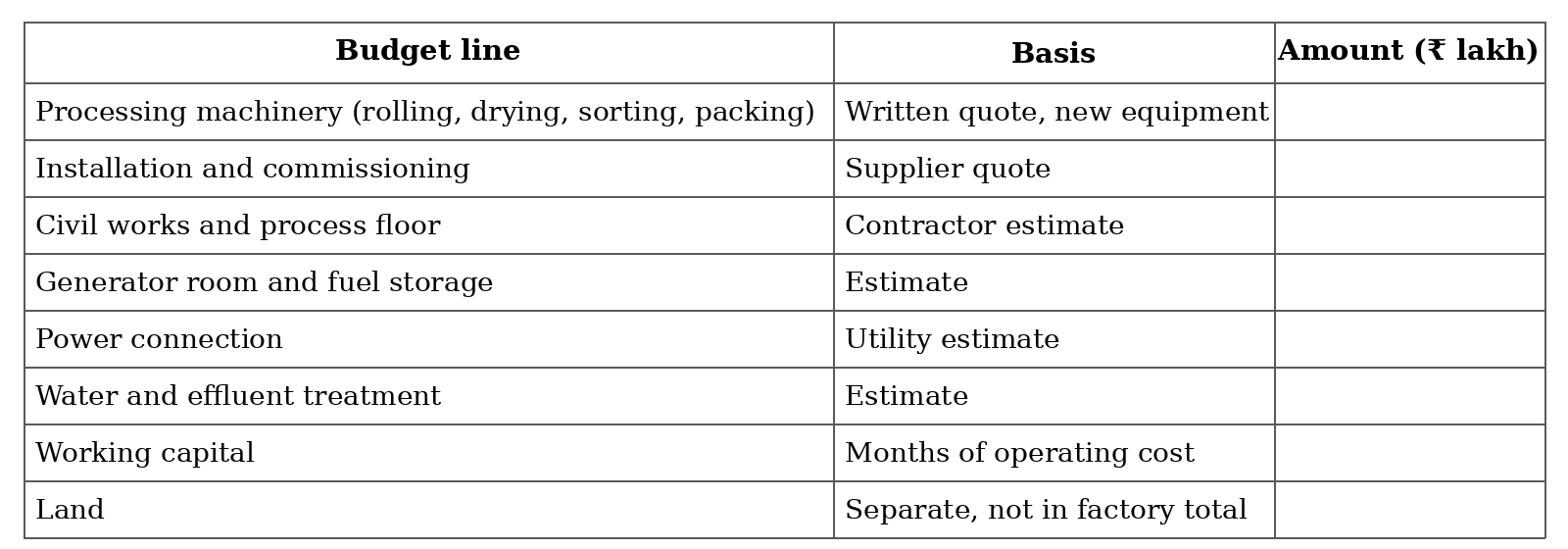
Add the factory rows, then compare the total against the subsidy base and your bank’s requirements.
Common mistakes that raise cost
- Mixing farm and factory costs. Planting and land inflate the factory figure and make quotes hard to compare.
- Using US benchmarks. Figures such as $250,000 to $500,000 for 10 hectares of US farmland, or USD 2 to 4 million for an instant tea plant at 1,000 MT a year, describe other products and markets. They are not Indian factory benchmarks.
- Trusting internal totals. One mini-factory sheet reviewed lists ₹40 lakh for plant and machinery, while its project cost totals ₹16.82 lakh. Check that subtotals add up before you rely on any sheet.
- Ignoring tea type. CTC, orthodox, green, and blending lines need different machines, and a budget built for one may not fit another.
- Forgetting working capital. The first months of leaf purchases need cash before the first sale.
- Assuming used machinery qualifies for the subsidy. Under the 2024 letter, it does not.
If you have a capacity and tea type in mind, the most useful next step is a machine list with written prices for your line. T&I Global can quote a CTC line for your output. See CTC tea machinery from T&I Global to compare the equipment and request a quotation.
Frequently asked questions
1. How much does it cost to set up a small tea factory in India?
One NIIR-sourced guide puts a small unit making 150 to 200 kg of finished tea a day at about ₹22 lakh, excluding land. A mid-scale unit at 400 kg a day is estimated at ₹40 to 45 lakh on the same basis. These are indicative figures, so get written quotes for your own capacity and tea type before you commit.
2. Is a Tea Board subsidy available for a mini tea factory?
A 2024 Tea Board letter offers 40% of the actual machinery and civil works cost for new mini tea units set up by self-help groups, farmer producer organisations, or farmer producer companies. The ceiling is ₹33 lakh per factory, excluding land. Older documents describe a 25% rule, so confirm the current scheme with the Tea Board.
3. Can I buy used machinery and still get the subsidy?
No. The 2024 Tea Board letter states that assistance is not given for used machinery. Budget for new equipment with a written warranty, and check the latest scheme text before you finalise your plan.
4. What machines does a CTC factory need compared with an orthodox or green tea factory?
A CTC line centres on rolling with two counter-rotating toothed rollers, typically 8 inches (20.3 cm) in diameter, followed by fermentation, drying and sorting. Orthodox and green lines add or change machines such as steamers, graders and packing equipment. Ask each supplier for the full machine list in writing, so you can compare quotes on the same basis.