Drying has a demanding role in tea processing. It must reduce the moisture in fermented tea to the required level, stabilise the product for subsequent handling and storage, and do so without compromising the characteristics developed during earlier processing stages. At the same time, the dryer has to handle the factory’s production volume without consuming more energy than necessary.
These objectives are closely connected. Increasing the feed rate changes the moisture load placed on the dryer. Increasing the drying temperature may accelerate moisture removal, but it can also alter energy use and affect the finished tea if the process is not appropriately controlled. Extending residence time may help achieve the required moisture level, but it can restrict throughput.
This is why tea-drying performance cannot be judged by capacity, fuel consumption, or outlet moisture alone. The more useful question is whether the dryer can maintain the required product condition consistently at the intended production rate and with efficient use of energy.
Achieving that balance begins with understanding how the three variables, energy, throughput, and quality, interact.
Energy, Throughput and Quality Are Not Separate Targets
A tea dryer operates within a set of interconnected process conditions. The amount and condition of tea entering the dryer determine the drying load, while temperature, airflow, and residence time influence how effectively that moisture can be removed.
Consider what happens when a factory tries to increase production simply by feeding more material into the dryer. A higher feed rate means more moisture must be removed within the available drying time. If the airflow, heat input, and residence time are not appropriate for the increased load, the result may be uneven or insufficient drying rather than genuinely higher production.
The same principle applies to temperature. Raising the drying temperature can increase the rate of moisture removal, but more heat is not automatically more efficient. Research on industrial tea drying has shown that drying temperature influences not only energy performance but also the chemical and sensory characteristics of the made tea. The appropriate operating condition therefore depends on the dryer, the incoming material, and the required finished product rather than on a universal temperature setting.
Residence time adds another part to the equation. Tea must remain under suitable drying conditions long enough to reach its target moisture consistently, but unnecessarily long residence times can restrict the quantity of material the dryer can process.
A factory may achieve higher hourly feed rates but experience greater moisture variation. It may reduce fuel consumption while sacrificing output. Or it may achieve the required final moisture while using considerably more thermal energy than necessary.
The objective, therefore, is not to maximise any one parameter. It is to find an operating window in which throughput, energy use and finished-tea requirements remain in balance.
Start With the Tea Entering the Dryer
A dryer can only perform as consistently as the material being fed into it allows. Before changing temperature, increasing airflow, or extending residence time, it is important to understand what is actually entering the drying chamber.
The moisture content of fermented tea is one of the most important variables. Tea arriving with a higher or more variable moisture load requires the dryer to remove more water under the same production conditions. If the incoming material changes significantly from one batch to another, a fixed set of dryer parameters may therefore produce different results.
Feed rate matters in much the same way. Increasing the quantity of tea entering the dryer increases the moisture load that must be handled within the available drying time. If the thermal input, airflow, and residence time are not matched to that additional load, final moisture can become inconsistent.
The physical characteristics of the tea also matter. Particle size, bed depth, and the way material is distributed through the dryer influence how evenly hot air can interact with the product. Uneven distribution can leave some material insufficiently dried while other portions receive more thermal treatment than necessary.
This means that dryer optimisation does not begin with the dryer alone. It begins by looking at the material flow into it.
This is also where the difference between rated capacity and sustainable throughput becomes important. A dryer may be capable of handling a particular quantity of tea per hour under specified conditions, but consistently achieving that output requires the incoming material, heat input, airflow, and residence time to remain within an appropriate operating range.
In other words, putting more tea through the dryer is only an increase in throughput if the required drying result is still being achieved consistently.
Energy Efficiency Is About Heat Utilisation, Not Just Fuel Consumption
When tea factories look for ways to reduce drying costs, the first instinct is often to focus on fuel consumption. While fuel efficiency matters, it does not tell the whole story. A more useful question is how effectively the heat supplied to the dryer is being used to remove moisture from the tea.
Some of the heat entering a drying system is inevitably lost through exhaust air, surfaces, and other parts of the system. Research on industrial tea drying has identified exhaust air as an important source of energy loss, particularly as drying progresses.
This makes the overall design and operation of the dryer important. Insulation can reduce heat losses from the equipment, while appropriate airflow helps transfer heat to the product more effectively. The heating system, air distribution, and exhaust arrangement also influence how much of the supplied thermal energy contributes to actual moisture removal.
Heat recovery can provide another opportunity. Instead of allowing useful thermal energy in the exhaust stream to leave the system unused, suitable heat-recovery arrangements can potentially redirect part of that energy back into the drying process. The feasibility and benefit, however, depend on the dryer configuration and operating conditions.
There is also a relationship between energy consumption and production load. Running a dryer significantly below its intended operating range does not necessarily mean that the factory is operating efficiently. Similarly, increasing the heat input simply to accommodate a higher feed rate can raise energy consumption without guaranteeing proportionally higher output.
A more meaningful assessment therefore looks beyond fuel consumed per hour and considers how efficiently the system converts its available thermal energy into useful drying.
Energy efficiency, in other words, is not simply about using less heat. It is about getting more useful drying work from the heat that the factory is already paying for.
Throughput: Don’t Confuse Rated Capacity With Effective Capacity
A tea dryer’s rated capacity provides an important reference, but it does not necessarily represent the output a factory can maintain under every production condition. Actual throughput depends on what is being fed into the dryer, how much moisture needs to be removed, and how the drying system responds to that load.
Consider a factory trying to increase production by raising the feed rate. If the incoming tea contains more moisture than usual, the additional material creates a substantially higher drying load. The dryer may still accept the increased quantity, but maintaining the required final moisture may then require changes to temperature, airflow, or residence time.
This is where simply pushing more material through the dryer can become counterproductive. If the available drying capacity is exceeded, the factory may see greater variation in outlet moisture or need to slow the line later to correct the problem.
Residence time is particularly important here. Tea needs sufficient exposure to the drying conditions to reach the required moisture level. Reducing residence time to increase hourly production may work within a suitable operating range, but beyond that point, the dryer may no longer provide enough opportunity for uniform moisture removal.
Feed consistency also affects effective throughput. Research into tea dryer control has demonstrated that changes in feed rate can cause significant changes in discharge moisture when the drying system does not adequately respond to those disturbances.
So when evaluating throughput, it is useful to distinguish between:
Rated capacity — what the equipment is designed to handle under specified conditions.
Actual throughput — how much tea the factory processes during production.
Effective throughput — how much tea can be processed while consistently meeting the required drying result.
That third measure is often the most meaningful one for production planning.
Tea Quality Puts a Limit on How Aggressively You Can Dry
The purpose of drying is not simply to remove as much moisture as possible, as quickly as possible. The drying stage also needs to preserve the characteristics developed during withering and fermentation while bringing the tea to a stable final condition.
This is where aggressive drying can become problematic. Increasing temperature or reducing residence time may appear to create more capacity, but the resulting process still needs to produce tea with the required moisture level and quality characteristics. Research on black tea drying has shown that changes in drying temperature can influence chemical composition and sensory properties, which means that temperature selection cannot be separated from the desired product outcome.
Uniformity is just as important as the final moisture reading. A batch may show an acceptable average moisture level while still containing variation between particles or portions of the product. Such variation can indicate that different parts of the tea have experienced different drying conditions.
Residence time and airflow therefore need to work together with temperature. Increasing temperature may accelerate moisture removal, but adequate air movement and sufficient residence time are still needed to achieve consistent drying throughout the material.
The target should also be defined by the product rather than by a universal number. Final moisture requirements can vary according to the type of tea, processing conditions, storage requirements, and applicable specifications. What matters is that the factory can reliably reach its defined target without excessive thermal treatment.
This changes the way drying performance should be evaluated. Instead of asking: How quickly can we remove the moisture? A better question is: How efficiently can we reach the required final condition while maintaining the desired tea quality?
That distinction is important when increasing production. A faster drying cycle is only beneficial if the tea coming out of the dryer continues to meet the required quality and moisture specifications.
What a Balanced Drying Strategy Looks Like
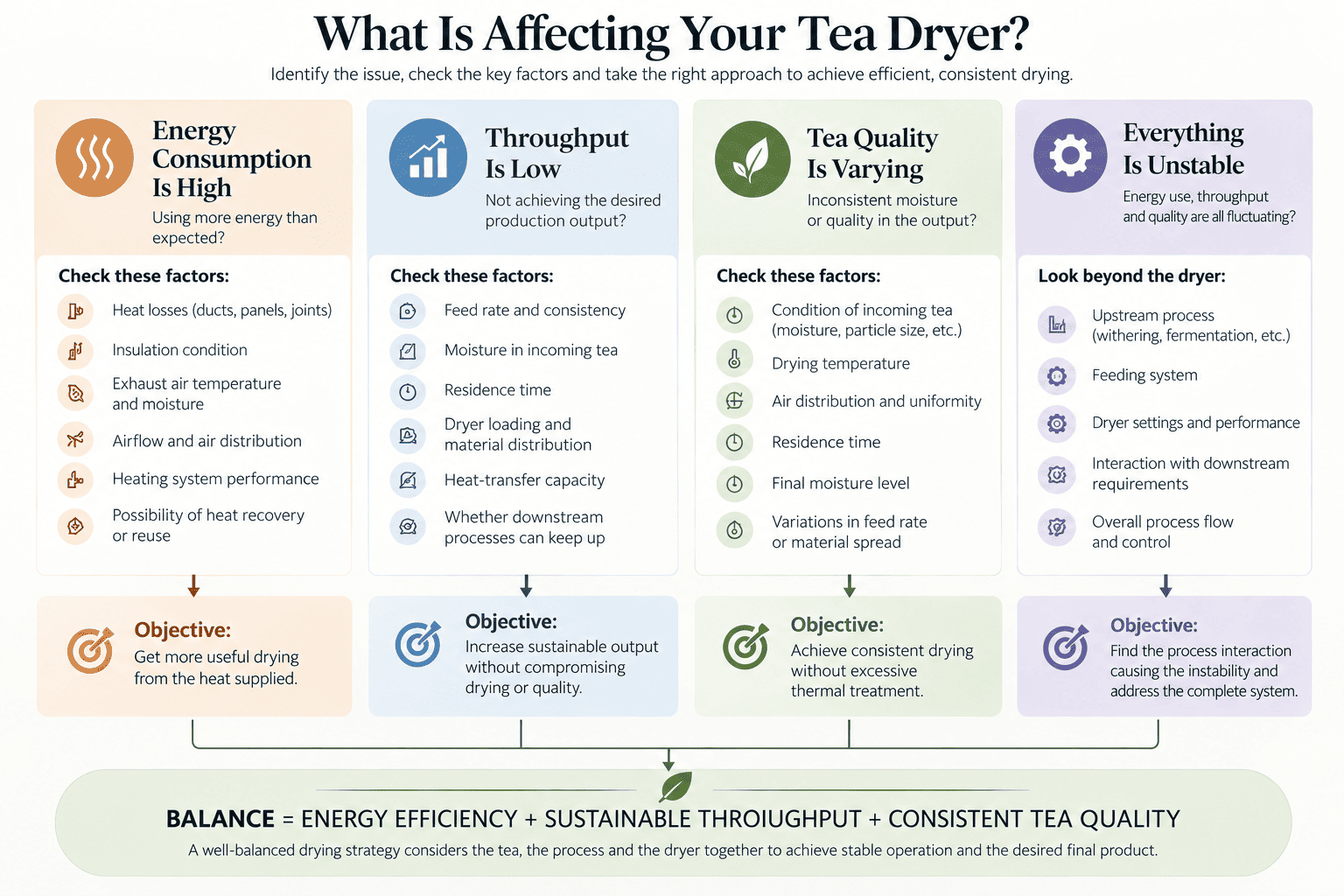
Balancing energy, throughput, and quality does not mean keeping every operating parameter fixed. In a real tea factory, the drying load can change with incoming tea, production rate, and process conditions. The more useful approach is to understand which variable is causing the change and adjust the process accordingly.
If energy consumption is higher than expected, the first step is not necessarily to reduce the drying temperature. Heat losses, insulation, airflow, exhaust conditions, heating-system performance, and the relationship between heat input and actual production load should be examined together.
If throughput is the constraint, increasing the feed rate is only one possible response. The factory also needs to consider whether residence time, airflow, and available heat-transfer capacity can support the additional load while maintaining the required final moisture.
If tea quality or moisture consistency is varying, attention should move toward the incoming material as well as the dryer itself. Variations in feed moisture, feed rate, material distribution, temperature, and residence time can all contribute to an unstable result.
And when energy, throughput, and quality are all fluctuating, the problem may not sit within the dryer alone. The relationship between upstream processing, feeding, drying conditions, and downstream requirements may need to be examined as a complete process.
This is why there is no single setting that can be called the most energy-efficient or the highest-throughput option for every tea factory. The appropriate operating window depends on the dryer configuration, tea characteristics, production requirements, and desired finished-product specifications.
Drying has a demanding role in tea processing. It must reduce the moisture in fermented tea to the required level, stabilise the product for subsequent handling and storage, and do so without compromising the characteristics developed during earlier processing stages. At the same time, the dryer has to handle the factory’s production volume without consuming more energy than necessary.
These objectives are closely connected. Increasing the feed rate changes the moisture load placed on the dryer. Increasing the drying temperature may accelerate moisture removal, but it can also alter energy use and affect the finished tea if the process is not appropriately controlled. Extending residence time may help achieve the required moisture level, but it can restrict throughput.
This is why tea-drying performance cannot be judged by capacity, fuel consumption, or outlet moisture alone. The more useful question is whether the dryer can maintain the required product condition consistently at the intended production rate and with efficient use of energy.
Achieving that balance begins with understanding how the three variables, energy, throughput, and quality, interact.
Energy, Throughput and Quality Are Not Separate Targets
A tea dryer operates within a set of interconnected process conditions. The amount and condition of tea entering the dryer determine the drying load, while temperature, airflow, and residence time influence how effectively that moisture can be removed.
Consider what happens when a factory tries to increase production simply by feeding more material into the dryer. A higher feed rate means more moisture must be removed within the available drying time. If the airflow, heat input, and residence time are not appropriate for the increased load, the result may be uneven or insufficient drying rather than genuinely higher production.
The same principle applies to temperature. Raising the drying temperature can increase the rate of moisture removal, but more heat is not automatically more efficient. Research on industrial tea drying has shown that drying temperature influences not only energy performance but also the chemical and sensory characteristics of the made tea. The appropriate operating condition therefore depends on the dryer, the incoming material, and the required finished product rather than on a universal temperature setting.
Residence time adds another part to the equation. Tea must remain under suitable drying conditions long enough to reach its target moisture consistently, but unnecessarily long residence times can restrict the quantity of material the dryer can process.
A factory may achieve higher hourly feed rates but experience greater moisture variation. It may reduce fuel consumption while sacrificing output. Or it may achieve the required final moisture while using considerably more thermal energy than necessary.
The objective, therefore, is not to maximise any one parameter. It is to find an operating window in which throughput, energy use and finished-tea requirements remain in balance.
Start With the Tea Entering the Dryer
A dryer can only perform as consistently as the material being fed into it allows. Before changing temperature, increasing airflow, or extending residence time, it is important to understand what is actually entering the drying chamber.
The moisture content of fermented tea is one of the most important variables. Tea arriving with a higher or more variable moisture load requires the dryer to remove more water under the same production conditions. If the incoming material changes significantly from one batch to another, a fixed set of dryer parameters may therefore produce different results.
Feed rate matters in much the same way. Increasing the quantity of tea entering the dryer increases the moisture load that must be handled within the available drying time. If the thermal input, airflow, and residence time are not matched to that additional load, final moisture can become inconsistent.
The physical characteristics of the tea also matter. Particle size, bed depth, and the way material is distributed through the dryer influence how evenly hot air can interact with the product. Uneven distribution can leave some material insufficiently dried while other portions receive more thermal treatment than necessary.
This means that dryer optimisation does not begin with the dryer alone. It begins by looking at the material flow into it.
This is also where the difference between rated capacity and sustainable throughput becomes important. A dryer may be capable of handling a particular quantity of tea per hour under specified conditions, but consistently achieving that output requires the incoming material, heat input, airflow, and residence time to remain within an appropriate operating range.
In other words, putting more tea through the dryer is only an increase in throughput if the required drying result is still being achieved consistently.
Energy Efficiency Is About Heat Utilisation, Not Just Fuel Consumption
When tea factories look for ways to reduce drying costs, the first instinct is often to focus on fuel consumption. While fuel efficiency matters, it does not tell the whole story. A more useful question is how effectively the heat supplied to the dryer is being used to remove moisture from the tea.
Some of the heat entering a drying system is inevitably lost through exhaust air, surfaces, and other parts of the system. Research on industrial tea drying has identified exhaust air as an important source of energy loss, particularly as drying progresses.
This makes the overall design and operation of the dryer important. Insulation can reduce heat losses from the equipment, while appropriate airflow helps transfer heat to the product more effectively. The heating system, air distribution, and exhaust arrangement also influence how much of the supplied thermal energy contributes to actual moisture removal.
Heat recovery can provide another opportunity. Instead of allowing useful thermal energy in the exhaust stream to leave the system unused, suitable heat-recovery arrangements can potentially redirect part of that energy back into the drying process. The feasibility and benefit, however, depend on the dryer configuration and operating conditions.
There is also a relationship between energy consumption and production load. Running a dryer significantly below its intended operating range does not necessarily mean that the factory is operating efficiently. Similarly, increasing the heat input simply to accommodate a higher feed rate can raise energy consumption without guaranteeing proportionally higher output.
A more meaningful assessment therefore looks beyond fuel consumed per hour and considers how efficiently the system converts its available thermal energy into useful drying.
Energy efficiency, in other words, is not simply about using less heat. It is about getting more useful drying work from the heat that the factory is already paying for.
Throughput: Don’t Confuse Rated Capacity With Effective Capacity
A tea dryer’s rated capacity provides an important reference, but it does not necessarily represent the output a factory can maintain under every production condition. Actual throughput depends on what is being fed into the dryer, how much moisture needs to be removed, and how the drying system responds to that load.
Consider a factory trying to increase production by raising the feed rate. If the incoming tea contains more moisture than usual, the additional material creates a substantially higher drying load. The dryer may still accept the increased quantity, but maintaining the required final moisture may then require changes to temperature, airflow, or residence time.
This is where simply pushing more material through the dryer can become counterproductive. If the available drying capacity is exceeded, the factory may see greater variation in outlet moisture or need to slow the line later to correct the problem.
Residence time is particularly important here. Tea needs sufficient exposure to the drying conditions to reach the required moisture level. Reducing residence time to increase hourly production may work within a suitable operating range, but beyond that point, the dryer may no longer provide enough opportunity for uniform moisture removal.
Feed consistency also affects effective throughput. Research into tea dryer control has demonstrated that changes in feed rate can cause significant changes in discharge moisture when the drying system does not adequately respond to those disturbances.
So when evaluating throughput, it is useful to distinguish between:
Rated capacity — what the equipment is designed to handle under specified conditions.
Actual throughput — how much tea the factory processes during production.
Effective throughput — how much tea can be processed while consistently meeting the required drying result.
That third measure is often the most meaningful one for production planning.
Tea Quality Puts a Limit on How Aggressively You Can Dry
The purpose of drying is not simply to remove as much moisture as possible, as quickly as possible. The drying stage also needs to preserve the characteristics developed during withering and fermentation while bringing the tea to a stable final condition.
This is where aggressive drying can become problematic. Increasing temperature or reducing residence time may appear to create more capacity, but the resulting process still needs to produce tea with the required moisture level and quality characteristics. Research on black tea drying has shown that changes in drying temperature can influence chemical composition and sensory properties, which means that temperature selection cannot be separated from the desired product outcome.
Uniformity is just as important as the final moisture reading. A batch may show an acceptable average moisture level while still containing variation between particles or portions of the product. Such variation can indicate that different parts of the tea have experienced different drying conditions.
Residence time and airflow therefore need to work together with temperature. Increasing temperature may accelerate moisture removal, but adequate air movement and sufficient residence time are still needed to achieve consistent drying throughout the material.
The target should also be defined by the product rather than by a universal number. Final moisture requirements can vary according to the type of tea, processing conditions, storage requirements, and applicable specifications. What matters is that the factory can reliably reach its defined target without excessive thermal treatment.
This changes the way drying performance should be evaluated. Instead of asking: How quickly can we remove the moisture? A better question is: How efficiently can we reach the required final condition while maintaining the desired tea quality?
That distinction is important when increasing production. A faster drying cycle is only beneficial if the tea coming out of the dryer continues to meet the required quality and moisture specifications.
What a Balanced Drying Strategy Looks Like
Balancing energy, throughput, and quality does not mean keeping every operating parameter fixed. In a real tea factory, the drying load can change with incoming tea, production rate, and process conditions. The more useful approach is to understand which variable is causing the change and adjust the process accordingly.
If energy consumption is higher than expected, the first step is not necessarily to reduce the drying temperature. Heat losses, insulation, airflow, exhaust conditions, heating-system performance, and the relationship between heat input and actual production load should be examined together.
If throughput is the constraint, increasing the feed rate is only one possible response. The factory also needs to consider whether residence time, airflow, and available heat-transfer capacity can support the additional load while maintaining the required final moisture.
If tea quality or moisture consistency is varying, attention should move toward the incoming material as well as the dryer itself. Variations in feed moisture, feed rate, material distribution, temperature, and residence time can all contribute to an unstable result.
And when energy, throughput, and quality are all fluctuating, the problem may not sit within the dryer alone. The relationship between upstream processing, feeding, drying conditions, and downstream requirements may need to be examined as a complete process.
This is why there is no single setting that can be called the most energy-efficient or the highest-throughput option for every tea factory. The appropriate operating window depends on the dryer configuration, tea characteristics, production requirements, and desired finished-product specifications.