Withering is one of the earliest stages in tea processing where the characteristics of the finished tea begin to take shape. After plucking, fresh leaves gradually lose moisture and become softer, making them easier to handle during subsequent processing. However, this physical change is only part of what happens during withering.
As the leaves lose water, their internal chemistry also changes. Research published in Food Chemistry in 2025 found changes in several groups of compounds during tea withering, including soluble sugars, free amino acids, terpenoids, and catechins. These compounds contribute in different ways to tea’s taste, aroma, and overall character.
This means that two batches of leaves can reach a similar moisture level yet develop different characteristics if they experience different withering conditions. Temperature, humidity, airflow, light exposure, and processing duration can all influence the outcome, although their effects vary with the tea type and manufacturing method.
Understanding withering therefore requires looking beyond how much moisture the leaves lose. It requires understanding how the conditions during this stage influence the physical and biochemical changes that contribute to the tea’s eventual flavour and aroma.
Withering Is Where Tea Quality Begins to Take Shape
Freshly plucked tea leaves are biologically active. Once they enter the factory, withering begins to change both their physical structure and their chemical composition. The gradual loss of moisture makes the leaves more pliable, helping them withstand subsequent handling, rolling, or other processing operations. But withering also initiates changes that influence the character of the finished tea.
One important part of this process is the transformation of compounds already present in the leaf. A 2025 study published in Food Chemistry used metabolomic, transcriptomic and biochemical analyses to investigate these changes. It reported increases in soluble sugars, free amino acids and terpenoids during the studied withering process, alongside a significant decrease in catechins. These compounds contribute differently to sweetness, savoury or umami notes, aroma and astringency.
The implications extend beyond the chemical composition of the leaf. The balance of these compounds helps shape how the tea develops through later processing stages. Withering therefore influences the raw material that enters rolling, oxidation, or drying, depending on the tea being manufactured.
However, there is no single chemical change that defines successful withering across all tea types. Research comparing different tea cultivars has found that metabolite profiles and their changes over time can vary between cultivars. The intended tea style and the characteristics of the incoming leaves must therefore be considered when evaluating the process.
For tea manufacturers, this makes withering an important quality-control stage rather than simply a preliminary step for reducing moisture. Its purpose is not only to prepare the leaf physically, but also to create suitable conditions for the transformations that contribute to the desired tea profile.
What Happens Inside the Leaf During Withering?
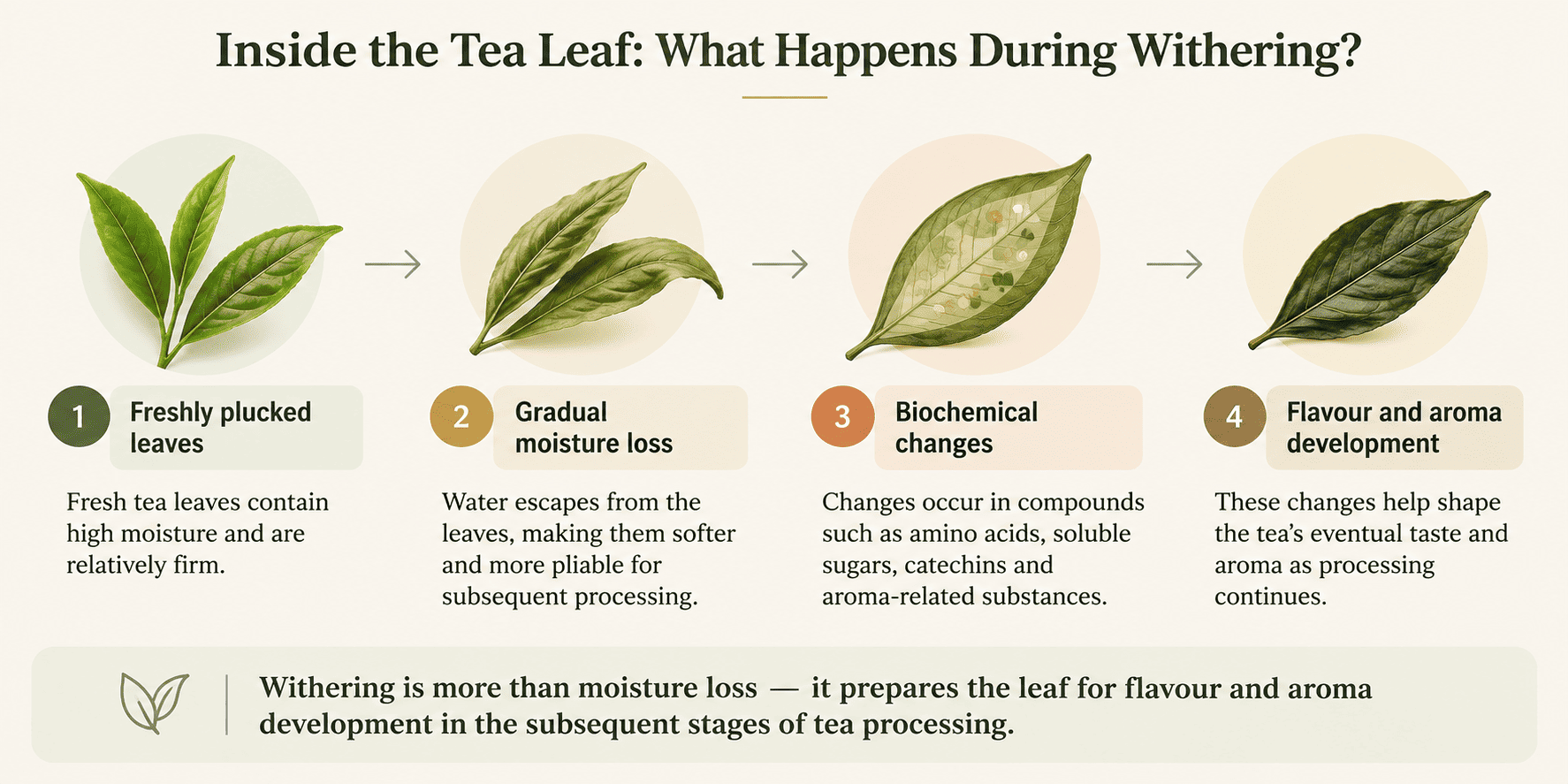
The changes that take place during withering are both physical and biochemical. While moisture gradually escapes from freshly plucked leaves, their internal structure and chemical composition also begin to change. These processes work together to prepare the leaves for subsequent manufacturing stages and influence the flavour and aroma that develop in the finished tea.
Moisture loss changes the leaf’s physical structure. Fresh tea leaves contain substantial moisture and are relatively firm. As water is lost, the leaves become softer and more pliable, allowing them to withstand rolling, twisting, or other mechanical treatments more effectively. The rate of moisture loss matters: uneven withering can leave some portions of a batch more flexible than others, creating inconsistencies during subsequent processing.
Biochemical activity changes the compounds within the leaf. Withering is not simply a drying process. Changes in the leaf’s cellular environment influence enzymatic and non-enzymatic reactions, affecting the balance of compounds associated with tea quality. In a 2025 Food Chemistry study, researchers observed increases in soluble sugars, free amino acids, and terpenoids, alongside a decrease in catechins during the studied withering process. The researchers also identified changes in proteins and other cellular components.
These compounds contribute differently to the tea’s eventual character. Amino acids are associated with savoury or umami notes, soluble sugars contribute to sweetness and overall taste balance, and terpenoids are involved in the formation of aroma compounds. Catechins, meanwhile, contribute to bitterness and astringency. The final sensory profile depends on the balance between these and other constituents, rather than on the concentration of any single compound.
Aroma development begins before the later processing stages. Changes during withering can influence the availability of aroma precursors and the formation of volatile compounds. These changes establish part of the chemical foundation on which subsequent processes, such as oxidation and drying, build. Withering therefore helps prepare the leaf for the flavour development that continues throughout manufacturing.
It is important to note that these changes do not follow an identical pattern in every batch of tea. Cultivar, leaf condition, processing method, and withering environment can all affect the outcome. The practical objective is therefore not to maximise one particular chemical change, but to achieve a suitable balance of moisture loss and biochemical development for the intended tea style.
How Withering Conditions Influence Aroma, Taste and Appearance
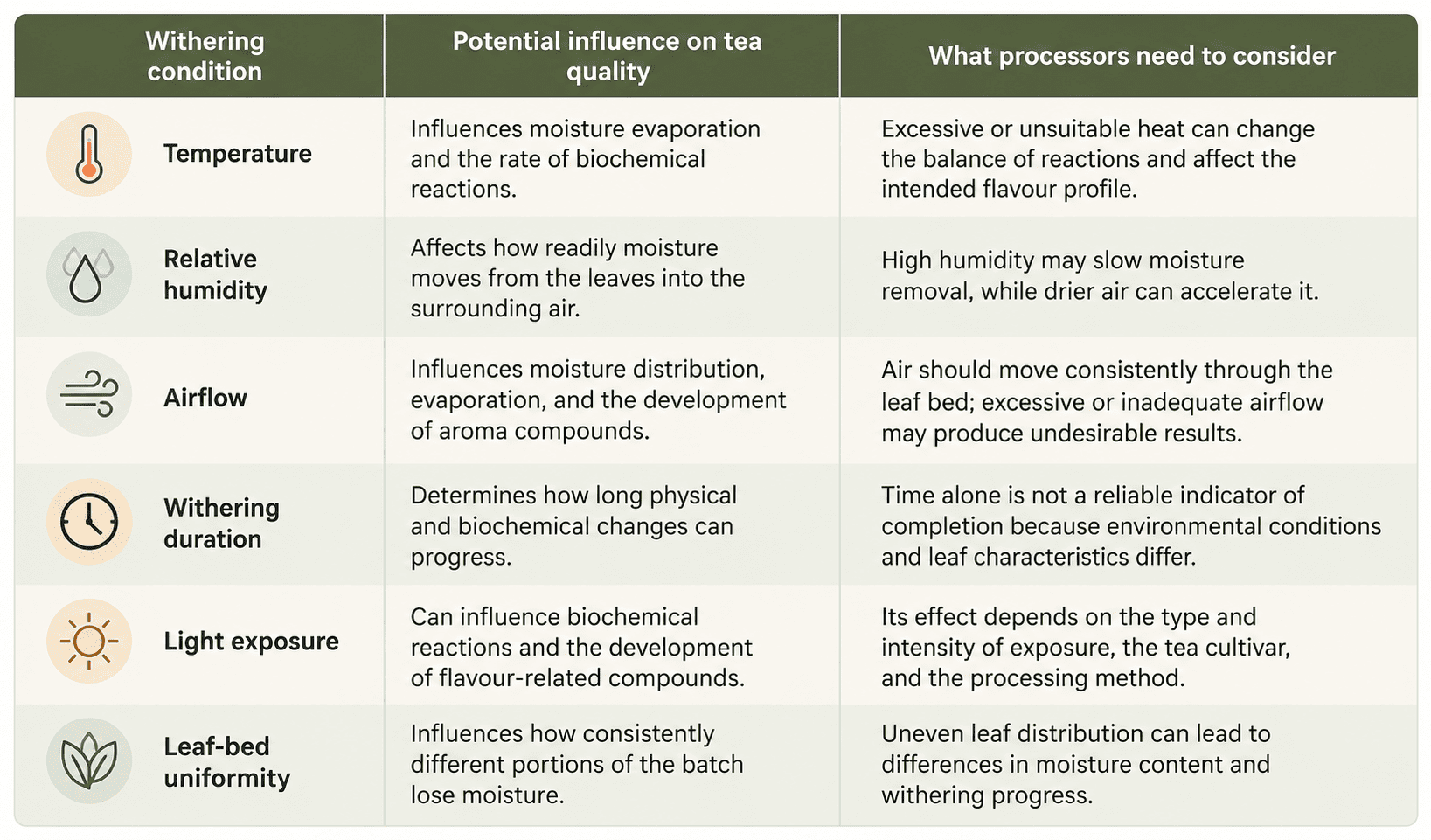
Withering conditions determine how quickly moisture leaves the tea leaf and how its internal compounds change during that process. Temperature, relative humidity, airflow, light exposure and duration interact with one another, so adjusting a single parameter can influence both the pace of withering and the characteristics of the processed leaf.
The effects are not always straightforward. Faster moisture loss does not automatically produce better tea, and extending the withering period does not necessarily improve flavour. The objective is to establish conditions that suit the leaf material and the desired tea profile.
The following table summarises how key process variables can influence quality.
Why balance matters more than speed
A 2025 study on white tea demonstrated that airflow can influence aroma in different ways depending on its intensity. Under the specific experimental conditions, moderate airflow supported the development of floral aroma characteristics, while a higher airflow treatment was associated with grassy notes. These findings illustrate why airflow must be evaluated in relation to the intended product rather than treated simply as a way to accelerate moisture removal. The results apply to the white tea conditions studied and should not be assumed to hold identically for every tea type.
For manufacturers, the practical challenge is to maintain conditions that allow the batch to progress consistently. A leaf bed with uneven airflow, for example, may contain areas at different stages of withering even when the overall processing time appears adequate. Similarly, relying only on elapsed time can overlook differences caused by incoming leaf moisture, ambient conditions, or variations between batches.
The key takeaway is that withering quality depends on the interaction between process conditions, leaf characteristics, and the intended tea style. Monitoring these factors together gives processors a more reliable basis for managing consistency than relying on a single setting or a fixed processing duration.
Why the Same Withering Conditions Don’t Suit Every Tea
Withering cannot be managed through a universal set of temperature, humidity, and duration settings. Different tea varieties and manufacturing methods require different degrees of moisture reduction and biochemical development. Conditions that support one tea style may not produce the same results in another.
The differences begin with the role that withering plays in each manufacturing process.
Black tea relies on withering to prepare the leaves for rolling or maceration and the subsequent oxidation stage. The leaves need to become sufficiently pliable for mechanical processing, while their internal chemical composition continues to change. Inadequate or excessive withering can affect how the leaves behave during later processing and influence the resulting flavour and liquor characteristics.
Oolong tea requires a different approach because withering is part of a more complex sequence that may include controlled leaf handling, partial oxidation and repeated agitation. The degree of moisture loss and the way the leaves are handled must support the intended balance of aroma and flavour. Simply applying a black tea withering schedule may not deliver the desired outcome.
White tea is often processed with comparatively minimal intervention, making the withering stage particularly important to its development. The pace of moisture loss and the environmental conditions can influence its aroma profile. Research on different tea styles shows that their flavour characteristics emerge from distinct combinations of processing steps rather than from withering alone.
Green tea, by contrast, generally uses little or no conventional withering in many manufacturing methods because early heat treatment is used to deactivate enzymes and limit oxidation. The exact sequence depends on the style being produced. This illustrates why withering should always be considered within the wider manufacturing process, rather than treated as an isolated operation.
Factors that make each batch different
Even within the same tea category, the ideal process can vary. Important considerations include:
- Cultivar and leaf maturity: Different leaves begin with different chemical compositions and physical characteristics.
- Incoming leaf condition: The moisture content, plucking standard, and handling history influence how leaves respond during withering.
- Ambient conditions: Changes in temperature and humidity can alter the rate of moisture removal.
- Target product profile: The intended aroma, taste, appearance, and subsequent processing steps determine the required withering endpoint.
A 2026 systematic review of black tea research found substantial variation in the reported effects of different withering conditions. It highlighted cultivar, final moisture content, dehydration rate, and sampling stage as important factors in interpreting results. This reinforces the need to evaluate process settings in their specific manufacturing context rather than assume that one method will work consistently everywhere.
For tea manufacturers, the practical lesson is clear: standardisation should mean consistent results, not necessarily identical settings for every tea. Establishing suitable operating conditions for each product, then monitoring them throughout production, provides a more reliable route to repeatable quality.
From Traditional Judgement to Measurable Process Control
In many tea factories, withering progress has traditionally been assessed through a combination of operator experience, leaf feel, appearance and processing time. These observations remain valuable because they help experienced tea makers recognise changes in leaf condition. However, as production volumes increase and consistency becomes more important, relying on subjective assessment alone can make it difficult to reproduce the same results across batches.
The challenge is that the same processing time does not necessarily produce the same degree of withering. Incoming leaf moisture, leaf-bed thickness, ambient humidity and airflow can vary throughout the day. A batch processed for a fixed duration may therefore reach a different moisture level from one processed under different conditions.
What can manufacturers monitor?
A more controlled approach combines practical leaf assessment with measurable process parameters.
- Temperature and relative humidity: Tracking these variables helps operators understand the environment in which moisture loss and biochemical changes are occurring.
- Airflow and ventilation: Monitoring air movement helps identify conditions that may contribute to uneven moisture removal across the leaf bed.
- Moisture loss over time: Following the rate of weight or moisture reduction provides a clearer picture of how the batch is progressing than elapsed time alone.
- Leaf-bed uniformity: Consistent leaf distribution supports more even exposure to the process environment.
- Batch records: Recording operating conditions and the resulting tea characteristics helps factories identify repeatable settings and investigate inconsistencies.
These measurements are most useful when considered together. For example, a slower-than-expected moisture-loss trend may indicate that airflow or environmental conditions need attention. Operators can then investigate the cause rather than extending the process automatically.
How automation can support consistency
Modern monitoring and control systems can collect environmental data and adjust heating or ventilation in response to changing conditions. A 2025 study published in Scientific Reports described an intelligent tea-withering control system that monitored temperature and humidity and automated heating and ventilation-dehumidification functions. The research illustrates how process monitoring can reduce dependence on manual adjustments and support more consistent operating conditions. The actual benefits, however, depend on the equipment, control strategy, and factory operating environment.
Automation does not eliminate the need for skilled tea-processing personnel. Instead, it gives operators better information with which to make decisions, investigate deviations, and maintain control over the process. The sensory evaluation of the leaves and the quality of the finished tea remain important when determining whether a particular set of conditions is suitable.
For tea manufacturers, the objective is to move towards repeatable quality supported by measurable process data. Combining operator experience with consistent monitoring, suitable equipment, and recorded batch results can make withering easier to manage as production demands change.
Building Tea Quality Through Controlled Withering
Withering is far more than a preliminary moisture-removal stage. It influences the physical condition of the leaf, the transformation of flavour-related compounds and the characteristics that develop during subsequent processing. Temperature, humidity, airflow, processing duration and leaf condition all contribute to the outcome, making a balanced and well-managed process essential for consistent tea quality.
For tea manufacturers, the goal is not simply to achieve a target moisture level, but to establish withering conditions that suit the intended tea style and remain repeatable across batches. Combining experienced operator judgement with process monitoring and appropriate equipment can help factories manage variability, identify inconsistencies and maintain greater control over production.
At T&I Global, tea-processing solutions are developed with a focus on process control, operational consistency and the requirements of modern tea manufacturing. By approaching withering as an integral part of the wider processing line, manufacturers can work towards more predictable processing conditions and consistent product quality.
Frequently Asked Questions (FAQs)
1. Why is withering important in tea processing?
Withering prepares freshly plucked tea leaves for subsequent processing by reducing moisture and making them more pliable. It also triggers physical and biochemical changes that influence the development of flavour, aroma, and colour. The extent of these changes depends on the tea type, leaf characteristics and processing conditions.
2. How do temperature and humidity affect tea withering?
Temperature and relative humidity influence the rate at which moisture leaves the tea and the biochemical reactions occurring within the leaf. High humidity can slow moisture removal, while lower humidity may accelerate it. Temperature also affects the rate of chemical and enzymatic activity, so both parameters need to be managed according to the intended tea style and the condition of the leaves.
3. Can withering conditions change the flavour and aroma of tea?
Yes. Withering conditions influence the compounds associated with tea’s taste and aroma. Research on white tea, for example, has shown that airflow intensity can affect the development of floral and grassy aroma characteristics. However, the results depend on the tea variety and manufacturing method, so the ideal conditions for one tea may not suit another.