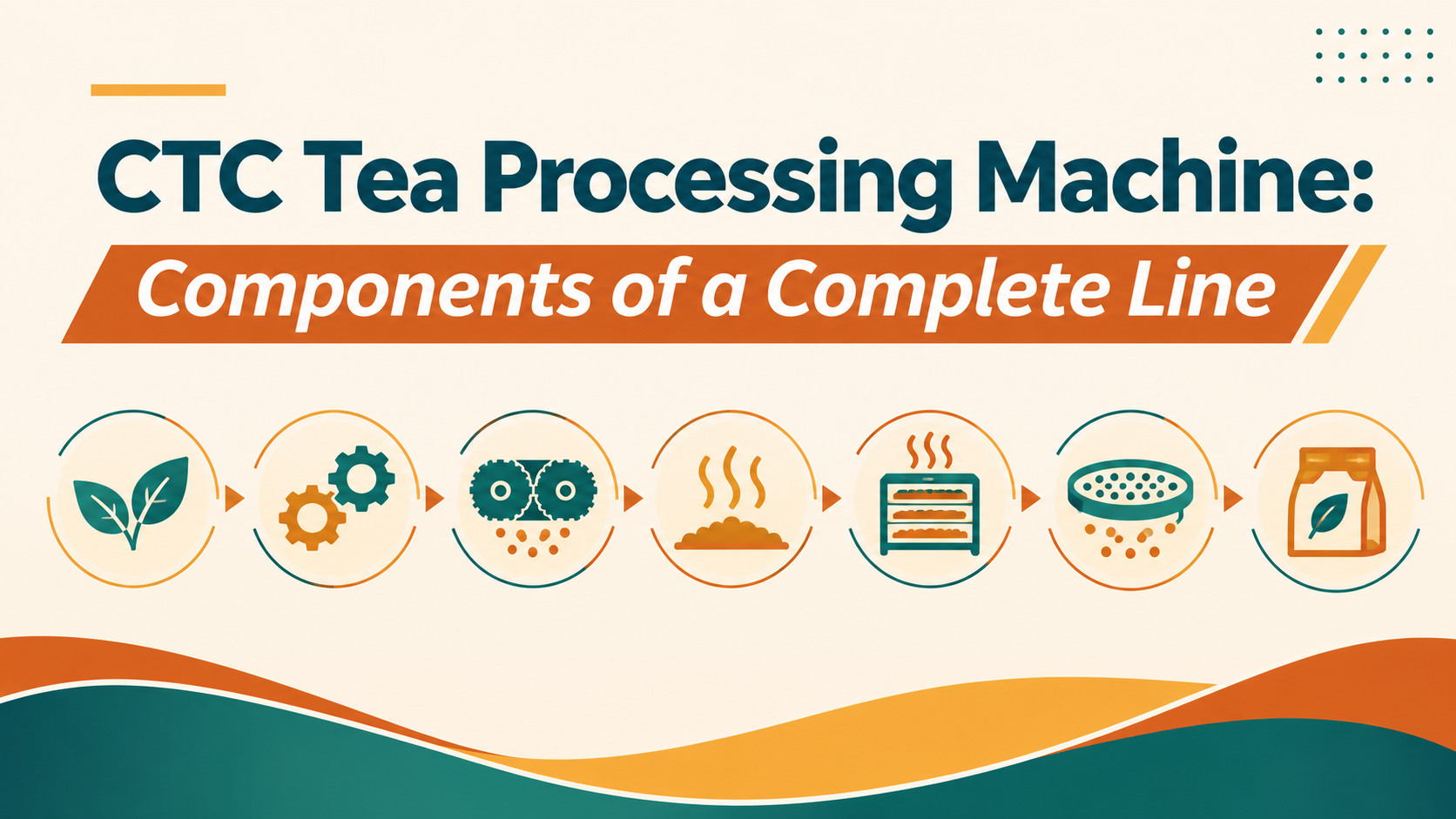
A CTC tea processing machine crushes, tears, and curls withered leaves between toothed rollers. It is only one part of a complete line, which also includes withering, conditioning, oxidation, drying, sorting, and packing equipment that must be sized to work together.
This guide lists each machine in order, explains how to match capacities, and shows what to maintain and ask a supplier. T&I Global has built tea machinery since 1949, so examples draw on its CTC tea machinery range.
What a CTC Tea Processing Machine Does
CTC stands for Crush, Tear and Curl. UPASI Tea Research Foundation describes withered leaf passing between two rollers that rotate in opposite directions. The result is small, dense granules that brew fast and strong. William McKercher is credited with inventing the CTC machine in Assam around 1930, according to Africa Tea.
How the Rollers Work
A CTC cutter has two toothed rollers of equal diameter turning in opposite directions. UPASI notes that after preconditioning, leaf passes through four or five CTC machines in tandem. Each pass cuts the leaf finer.
Some supplier guides describe “vertical axis rotor-stator” or “horizontal drum” CTC types. That is not how CTC lines in India and East Africa are built. The standard layout is tandem pairs of grooved, contra-rotating rollers.
CTC vs Orthodox Machinery
The two systems share withering and drying but differ in the middle of the line.
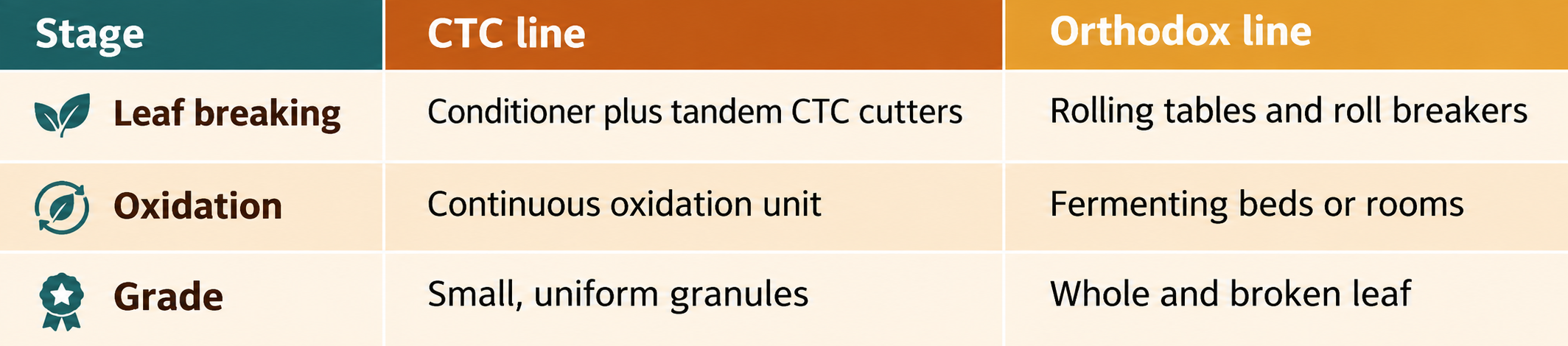
If you plan to make leaf styles as well as granules, look at orthodox and green tea machinery alongside the CTC range.
The Complete CTC Line, Step by Step
The CTC steps, per UPASI, are withering, green leaf shifting, reconditioning, rolling, fermentation, drying, grading and sorting, and packing. The table maps each to its machine.
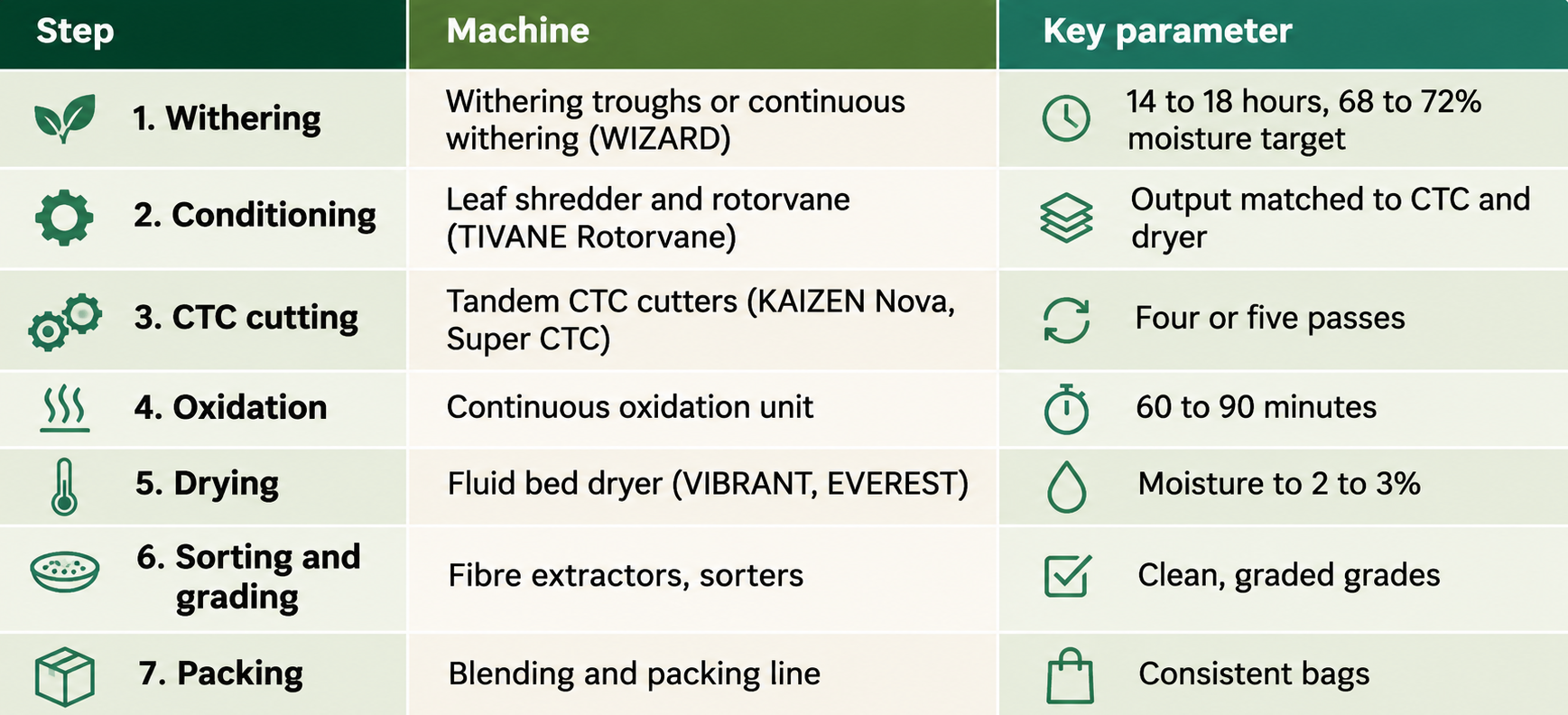
Withering figures come from Africa Tea and the TNAU Agritech portal.
Withering
Withering softens the leaf and removes moisture before cutting. Troughs are common, and continuous withering reduces handling. Uneven withering shows up later as uneven cut and uneven oxidation.
Conditioning
UPASI considers a leaf shredder and rotorvane combination ideal for conditioning. The rotorvane prepares the leaf so the cutters can work evenly.
CTC Cutters
The cutters are the heart of the line. Roller diameter and length set capacity. Pioneer-style catalogues list sizes such as 24, 30, 36 and 48 inches, while T&I Global’s KAIZEN Nova is offered with 13, 9 and 8 inch roller options. Confirm current figures on the manufacturer’s own spec sheet.
Oxidation
The step is commonly called fermentation, but it is oxidation, not microbial fermentation. A continuous unit holds the cut leaf for roughly 60 to 90 minutes with controlled airflow and humidity.
Drying
Drying stops oxidation and lowers moisture from 55 to 60% down to 2 to 3%, according to UPASI and TNAU. It is also the most costly step in energy terms. Source figures for inlet temperature differ: UPASI gives 100 ± 5°C as optimal for CTC leaf on an older page, while a tea brand guide cites 120 to 140°C for vibro fluid bed dryers. Treat these as ranges and follow your dryer maker’s settings. For the trade-offs, see balancing energy, throughput and quality in drying.
Sorting, Grading and Packing
After drying, fibre is removed, and the tea is graded. Tea sorting machines separate grades, and blending and packing equipment keeps the finished product consistent.
Sizing a Line: Matching Capacities Across Stages
A line runs at the speed of its slowest stage. UPASI states that conditioning output should match the CTC and dryer capacities. Follow these steps when sizing:
- Start with peak daily green leaf, not the average.
- Convert to hourly leaf at the cutter, based on your plucking pattern and running hours.
- Size withering to hold the peak day load for the full withering time.
- Match the shredder, rotorvane, and CTC cutters to the target hourly rate.
- Size the dryer on moisture removal, since inlet moisture changes its real output.
For reference, the KAIZEN Nova is listed at roughly 600 to 1,400 kg/h of leaf depending on model and roller size, and the EVEREST vibro fluid bed dryer comes in three models from 225 to 650 kg/h at 70% inlet moisture (verify against the current spec sheet). Capacity is quoted at specific moisture, so compare like with like.
A mismatched line shows up as a bottleneck. Our guide to finding the real bottleneck in a tea factory explains how to spot it, and consistent feeding shows why steady input matters.
Cost: What Drives CTC Machine and Plant Price
Marketplace listings in India range widely. One directory lists around ₹12 lakh for a 600 kg/h machine, ₹19 lakh for a CTC machine, and ₹27 lakh for a 1,000 kg/h plant (IndiaMART listings, unverified). Treat these as indicative only, because they do not say what is included.
What moves the price:
- Capacity and roller size of each stage
- Whether the quote covers a single machine or the full line
- Dryer type, air heater and fuel system
- Level of automation and controls
- Boilers, electricals, installation and commissioning
For a fuller breakdown, read what drives CTC machine cost in India and the tea factory machinery and utilities budget. To price your own plant, request a quote for your capacity.
Automation, Maintenance and Choosing a Supplier
Automation and Controls
Automation reduces labour and keeps stages in balance. Options include Smart Feed, Smart Discharge, Coal Saver, Dryer Automation and CFM Automation. See T&I Global’s automation range and the case study on automating CTC processing for consistent quality. Real-time monitoring helps catch drift before it reaches the cup.
Maintenance
UPASI is direct on one point: quality CTC tea cannot be made with worn or damaged roller teeth. Plan for:
- Scheduled roller inspection and recutting or replacement
- Spares for bearings, belts and feeders on hand
- Dryer cleaning and air heater checks
- Energy tracking per kilogram of made tea
Supplier Checklist
Ask every supplier:
- Which stages are included, and at what capacity and moisture?
- Are specifications on a manufacturer spec sheet?
- What spares, service, and training are offered locally?
- Can they supply boilers, electricals, installation, and commissioning?
- Can they show installations of similar size?
T&I Global is ISO 9001:2015 certified, with its factory in Coimbatore and an East Africa office in Kenya. For a full plant, see turnkey solutions. Small growers can start with a mini tea processing line.
Final Thoughts
A CTC tea processing machine performs best as part of a balanced line. Size every stage to the same hourly output, protect the roller teeth, and choose a supplier who can support the plant after commissioning. For a layout view, see the tea factory layout.
To see how the stages fit together, explore our CTC tea machinery range.