A tea factory does not necessarily need an entirely new processing line to move forward. Sometimes, a few well-planned equipment upgrades can improve the capabilities of an existing setup. In other situations, continuing to repair ageing machinery may cost more in the long run than replacing it.
This creates an important decision for tea manufacturers: should they upgrade their existing equipment or invest in new machinery?
The answer depends on more than the age of the equipment. Its mechanical condition, maintenance history, production requirements, compatibility with other systems, and expected future use all play a role.
Modernisation is not simply about acquiring newer machines. It is about identifying what the factory needs and choosing an investment that makes operational and financial sense.
Why Do Tea Factories Consider Modernisation?
Over time, the requirements of a tea factory can change. Equipment that once served its purpose may no longer be suitable for the factory’s current or future needs.
Some common reasons include:
- Ageing machinery: Wear and deterioration can affect reliability, particularly when equipment has been operating for many years.
- Increasing maintenance requirements: Frequent repairs, difficult-to-source spare parts, and longer servicing periods can make existing equipment harder to maintain.
- Changing production requirements: New tea varieties, product formats, or production volumes may require capabilities that the existing setup cannot provide.
- Outdated equipment design: Older machinery may lack the flexibility or technical features needed for current manufacturing requirements.
- Expansion plans: A factory planning to increase production may need to reassess whether its existing machinery can support the intended capacity.
However, identifying a reason to modernise does not automatically mean replacing the equipment. The next step is understanding which type of intervention is appropriate.
Upgrade, Refurbish or Replace: Understanding the Difference
Although these approaches are sometimes used interchangeably, they represent different levels of investment.
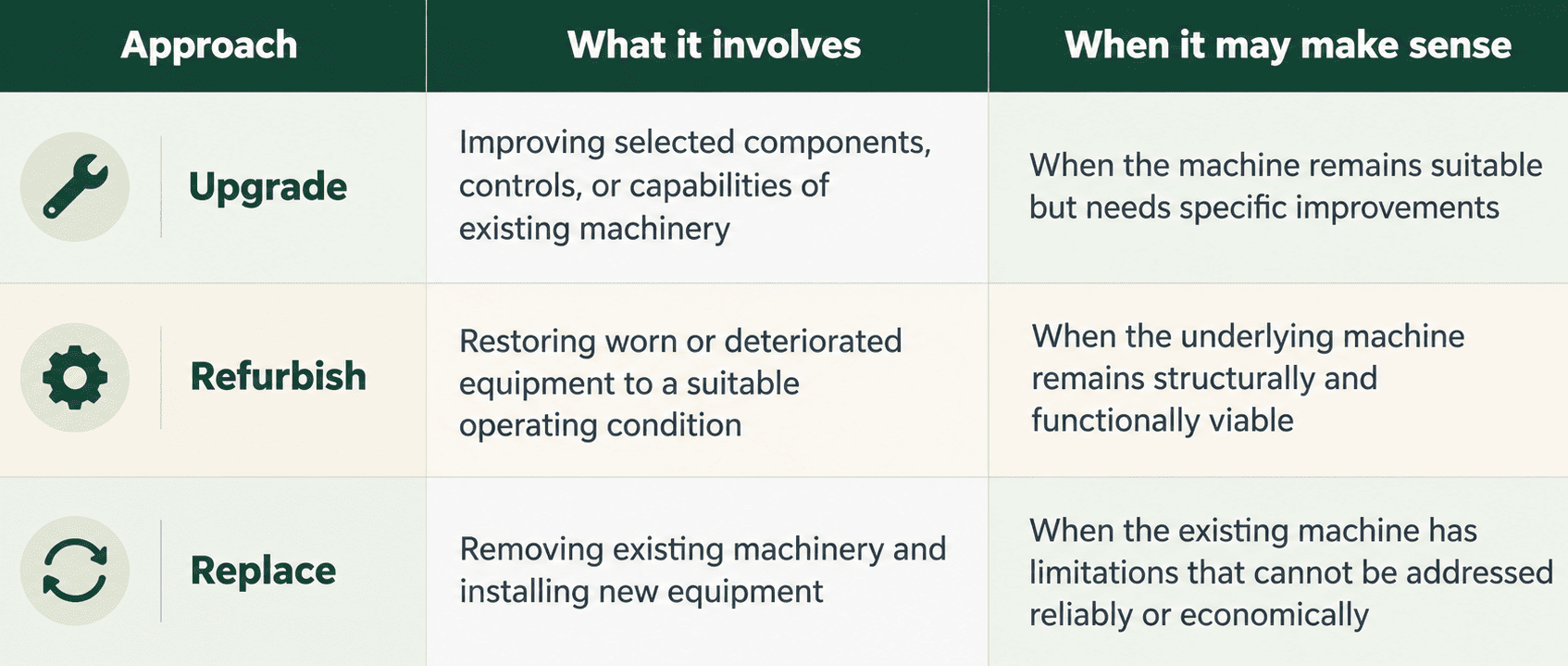
For example, a tea factory may have withering troughs that are structurally sound but use older fan arrangements. Upgrading selected components could be a more practical decision than replacing the entire installation.
On the other hand, a machine with significant structural deterioration or a design that no longer supports the required production process may justify complete replacement.
The distinction matters because each option involves different investment levels, installation requirements, and expected benefits.
When Is Upgrading Existing Machinery the Better Choice?
Upgrading can be a sensible option when the machine’s basic structure and operating principle remain suitable for the factory’s requirements.
Rather than replacing an entire machine, manufacturers can evaluate whether selected improvements would address its limitations.
Possible upgrade areas include:
- Mechanical components: Replacing worn or outdated components while retaining the main machine structure.
- Electrical systems: Updating electrical components and control arrangements where technically appropriate.
- Drive systems: Introducing suitable motor or drive improvements to support the intended operating requirements.
- Equipment integration: Modifying existing machinery to work with additional or upgraded equipment.
- Production flexibility: Adapting equipment to accommodate new product formats or processing requirements.
A practical example comes from tea factory modernisation projects involving withering troughs. Helix Engineering has documented projects where existing troughs were upgraded with energy-efficient fans and variable frequency drives rather than being completely replaced.
This illustrates how targeted improvements can extend the usefulness of existing installations.
However, an upgrade is only worthwhile when the underlying equipment can support the proposed changes. Adding new components to a machine with fundamental mechanical limitations may simply postpone a larger replacement decision.
When Does Replacement Become Necessary?
There comes a point when improving an existing machine is no longer the most practical option.
Replacement deserves serious consideration when the equipment has limitations that cannot be resolved through reasonable upgrades or refurbishment.
Some indicators include:
1. Significant structural deterioration
If the main frame, supporting structure, or essential mechanical assemblies have deteriorated considerably, restoring the machine may become difficult or uneconomical.
2. Persistent reliability problems
Repeated breakdowns, recurring component failures, and extended repair periods can make continued operation increasingly difficult to plan.
3. Limited availability of spare parts
When essential components are obsolete or difficult to source, maintaining the equipment can become a long-term challenge.
4. Fundamental design limitations
An existing machine may simply be unsuitable for the product, processing method, or production requirements the factory intends to adopt.
5. High cumulative repair costs
If maintenance and repair expenditure continues to increase without providing dependable operation, replacement may offer better long-term value.
The key is to distinguish between problems that can be corrected and limitations that are inherent to the equipment itself.
The Financial Side: Look Beyond the Purchase Price
One of the biggest mistakes in modernisation planning is comparing the cost of an upgrade directly with the purchase price of a new machine.
The initial investment is only one part of the calculation.
A more useful comparison considers the expected cost of keeping the existing equipment versus the total cost of installing and operating its replacement.
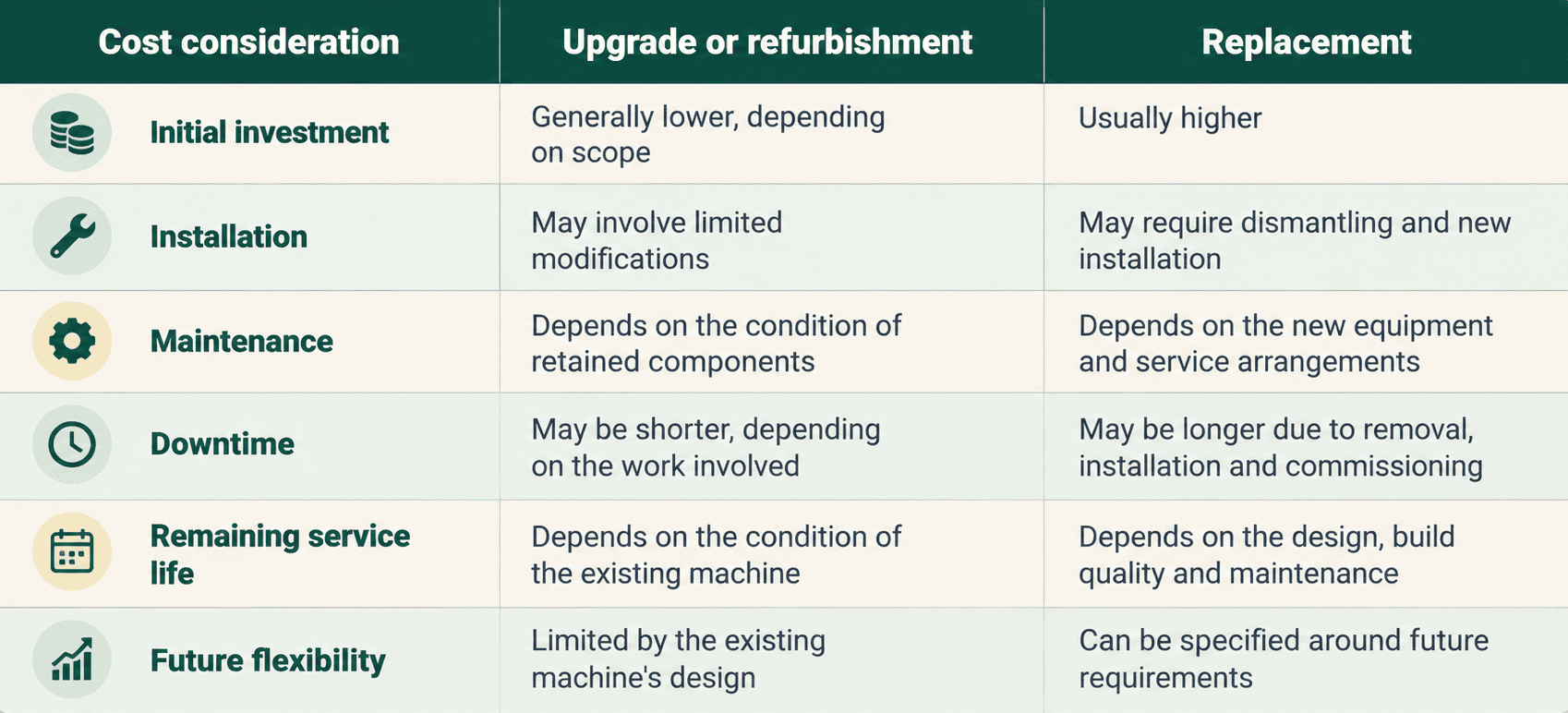
These are general considerations, not guaranteed outcomes. A major refurbishment can sometimes cost considerably more than expected, while replacing a machine may involve additional expenses for foundations, electrical connections, utilities, and integration.
Before making a decision, factories should consider:
- The estimated investment for each option.
- Expected maintenance and repair expenditure.
- Installation and commissioning costs.
- Production downtime during the work.
- Expected remaining service life.
- The production requirements the equipment must meet.
The better choice is the one that delivers suitable performance and dependable service over its expected working life, not necessarily the one with the lowest initial price.
What Should a Tea Factory Evaluate Before Making the Decision?
Before approving a modernisation project, it is worth carrying out a structured assessment of the existing equipment and the factory’s future requirements.
Use this checklist as a starting point:
✓ Equipment condition: Are the machine structure, major assemblies, and essential components in suitable condition?
✓ Maintenance history: How frequently does the equipment require repairs, and are failures becoming more difficult to resolve?
✓ Spare parts: Can essential replacement parts still be sourced reliably?
✓ Production requirements: Does the equipment meet the factory’s current processing needs?
✓ Future requirements: Will it support planned production volumes, product formats and processing changes?
✓ Compatibility: Can it work with the existing and planned equipment around it?
✓ Infrastructure: Are the available space, electrical supply, utilities and supporting arrangements suitable?
✓ Investment viability: Does upgrading or refurbishing offer a reasonable long-term return compared with replacement?
This assessment should involve the people who understand the equipment’s actual operating condition, including factory engineers, maintenance teams and production personnel.
It is also important to evaluate the entire installation rather than judging a machine in isolation. A replacement may require modifications to adjoining equipment, material handling arrangements or factory infrastructure.
Modernising One Machine or the Entire Factory?
Modernisation does not have to happen all at once.
For many tea factories, a phased approach can be more practical. Instead of replacing an entire processing line, manufacturers can identify which machines require immediate attention, which can be upgraded, and which can continue operating without major intervention.
This allows investment to be prioritised according to equipment condition, production requirements, and available resources.
For example, a factory may choose to upgrade selected components in machinery that remains structurally sound, while refurbishing equipment that requires mechanical restoration. Machines that can no longer meet the required production or operational standards may be replaced, with further improvements planned according to the factory’s longer-term production strategy.
A phased approach also allows manufacturers to plan installation work and production interruptions more carefully.
However, it requires proper technical assessment. Retaining one machine while replacing another is only practical when the resulting equipment configuration remains compatible.
For tea manufacturers considering equipment upgrades or replacement, choosing machinery that aligns with their production requirements is equally important. T&I Global offers a range of tea processing solutions, including CTC Tea Machinery and the WIZARD Continuous Withering System, designed for different stages of tea manufacturing. Exploring suitable equipment options can help factories plan their modernisation investments around their existing setup, processing requirements and future production goals.
Make the Investment That Makes Sense
Modernising a tea factory is not about replacing every older machine or upgrading every component available. It is about understanding the condition of existing equipment, identifying its limitations and deciding where investment will deliver meaningful long-term value.
For some factories, targeted upgrades may be sufficient. Others may benefit from refurbishment, while equipment with fundamental limitations may need complete replacement.
The decision should ultimately be guided by technical suitability, maintenance requirements, production objectives, and lifecycle costs.
The goal is not simply to install newer machinery. It is to build a tea processing setup that remains suitable, reliable, and commercially viable for the years ahead.