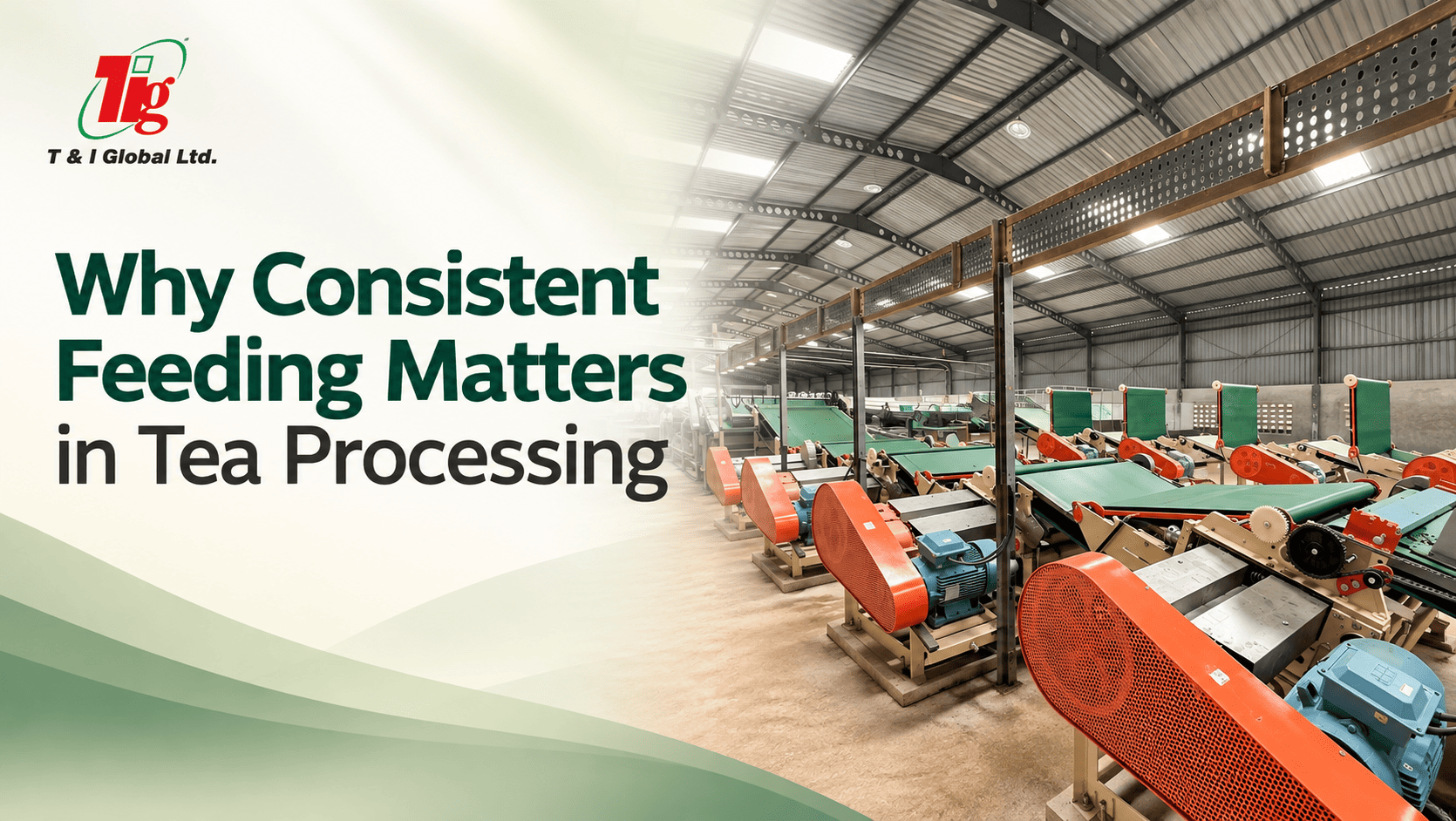
The Machine Can Only Work With What It Receives
A tea processing machine may be designed for a particular capacity, but that doesn’t mean it will perform at its best every time material enters it.
Imagine a CTC line receiving a steady, even flow of withered leaf. Now imagine the feed suddenly surging, slowing down or stopping altogether. The machine has not changed, yet the conditions under which it operates have.
This is why consistent feeding matters in tea processing. It’s not simply about getting enough leaf into a machine; it’s about supplying material at a suitable, steady rate so each stage can perform as intended. In CTC processing, for example, green-leaf sifting helps provide a more even flow of withered leaf to the machinery that follows.
The challenge for tea manufacturers is to find the right balance between keeping production moving and giving each machine the conditions it needs to do its job properly.
What Does Consistent Feeding Actually Mean?
Consistent feeding means delivering tea to a machine at an appropriate rate and in a reasonably uniform flow, without unnecessary surges, interruptions, or uneven distribution.
It doesn’t mean feeding as much leaf as possible. Nor does it mean maintaining exactly the same rate regardless of the condition of the leaf or the requirements of the process.
Three things matter:
- Rate: How much tea enters the machine over a given period.
- Uniformity: Whether the material is distributed reasonably evenly across the feeding area.
- Continuity: Whether the supply remains steady or is repeatedly interrupted.
These factors work together. A machine may receive the correct total quantity of tea over an hour but still experience periods of overfeeding followed by periods of underfeeding.
That distinction matters because the machine responds to the material it receives at any given moment, not simply the total quantity recorded at the end of a shift.
What Happens When the Feed Becomes Uneven?
The effects depend on the machine and the processing stage, but inconsistent feeding can introduce avoidable variation into production.
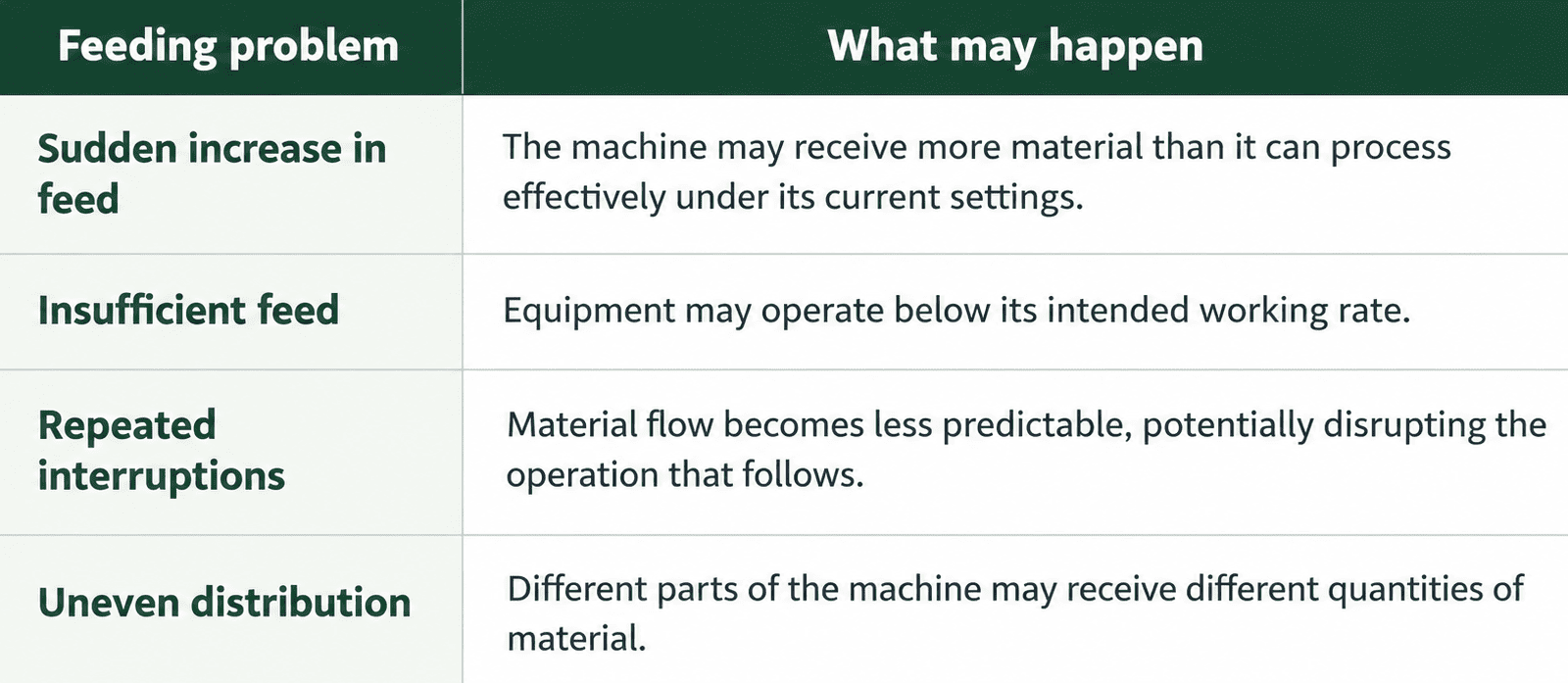
Consider a dryer. If more tea enters than the operating conditions can accommodate, the available drying time and heat may not be sufficient to achieve the intended result. If the feed rate drops significantly, the amount of material being processed changes, too.
The same principle applies elsewhere in the factory, although the consequences differ by equipment type.
The important point is that inconsistent feeding creates changing operating conditions, even when the machine settings remain unchanged.
One Processing Stage Can Affect the Next
Tea processing isn’t a collection of independent machines. What happens at one stage influences the conditions under which the next stage operates.
In CTC processing
The flow of withered leaf into the CTC section needs to suit the machinery’s operating conditions. Uneven supply can make it harder to maintain a steady operation, while excessive feeding may affect how effectively the leaf passes through the rollers.
The UPASI Tea Research Foundation’s CTC processing guide describes the role of green-leaf sifting and explains why correct feeding and roller operation matter to the manufacturing process.
In orthodox rolling
Rolling is influenced by several factors, including the quantity and condition of leaf charged into the roller, pressure, and processing time. The objective is not simply to process more leaf per batch, but to achieve the required degree of rolling for the tea being manufactured.
A larger charge isn’t automatically a better one. The appropriate loading depends on the roller and the processing requirements.
In drying
Feed rate affects how much tea passes through the dryer and how long it is exposed to the drying conditions. Changes in loading can therefore influence moisture removal and the consistency of the finished product.
The practical lesson is simple: a feeding problem can begin at one machine but become visible at another. That doesn’t mean every downstream variation is caused by feeding, but it makes feed consistency an important factor to investigate.
More Feed Doesn’t Always Mean More Production
When a factory wants to increase output, raising the feed rate may seem like the obvious first step.
But there’s a catch: the quantity entering a machine and the quantity it can process effectively are not necessarily the same.
If the feed rate exceeds what the equipment can handle under the current operating conditions, the additional material may compromise processing rather than improve output.
Tea drying offers a clear example. Research on industrial tea drying identifies feed quantity as one of the factors affecting drying behaviour, alongside operating conditions such as air temperature and airflow. The effect of changing the feed depends on the system and conditions being used.
Before increasing feed, manufacturers should consider:
- Is the machine receiving material evenly?
- Is the existing feed rate appropriate for the type and condition of tea?
- Can the following stage accept the additional output?
- Does the finished product still meet the required processing targets?
Increasing the feed rate can be useful when the equipment and downstream process can accommodate it. The goal, however, should be more effective production, not simply more material entering the line.
How Can a Tea Factory Improve Feeding Consistency?
Improving feeding consistency doesn’t always require a major equipment upgrade. It starts with understanding where and why the flow becomes uneven.
1. Establish a suitable feed rate
Set feeding targets according to the equipment, the condition of the leaf, and the requirements of the process. Avoid treating maximum feed as the default target.
2. Pay attention to distribution
Check whether the leaf is spread and delivered evenly, rather than accumulating in one area or entering in irregular surges.
3. Investigate interruptions
Look for blockages, bridging, inconsistent upstream supply, or feeding mechanisms that aren’t operating as intended. Repeated stoppages may be symptoms of a problem that needs attention.
4. Compare feed behaviour with the output
Check whether changes in feeding coincide with changes in machine performance or product results. This helps teams investigate the cause instead of adjusting settings by guesswork.
These checks provide a useful starting point. The exact corrective action will depend on the equipment and the problem identified.
Where Controlled Feeding Makes a Difference
As production requirements grow, relying entirely on manual adjustments can make it harder to maintain a steady material flow. Controlled feeding systems can help operators set and regulate feed rates, observe performance, and identify interruptions.
T&I Global’s Smart Feed is designed to support feeding operations with features that include feed-rate displays, output information, and production records.
The wider benefit is not just having a number on a screen. It is giving production teams better visibility into how material is being supplied to the line, helping them make more informed adjustments when necessary.
For a broader example of how feeding fits into an integrated production arrangement, see T&I Global’s CTC tea processing case study.
The key is to treat controlled feeding as part of the production system, rather than as a standalone fix. A feeding system cannot compensate for every downstream constraint, but it can help address variation introduced at the point where material enters the process.
A Steadier Feed Starts With a Better-Connected Process
Consistent feeding may seem like a small part of tea manufacturing, but its influence extends beyond the feeding point. It helps create more predictable operating conditions, supports the equipment that follows, and gives production teams a better starting point for achieving the desired results.
For tea manufacturers, the objective isn’t to feed more at every opportunity. It’s to feed appropriately, distribute evenly, and keep the process moving without avoidable interruptions. With solutions such as T&I Global’s Smart Feed, manufacturers can work towards better control over how material enters their processing lines.
Ultimately, good feeding is about giving every machine a fair chance to do its job well. A well-designed processing line can only deliver its potential when the material moving through it is supplied in a way the process can handle.