Tea processing has traditionally relied on a combination of process parameters, laboratory analysis, and the experience of production teams to determine whether tea is developing as expected. Measurements such as temperature, humidity, moisture, and processing time can tell a factory a great deal about what is happening inside the process. But they do not always tell the complete story of what is happening to the tea itself.
This is where data-driven quality monitoring is beginning to change the conversation.
Technologies such as near-infrared spectroscopy (NIRS), computer vision and electronic-nose systems are being studied for their ability to assess characteristics of tea during processing rather than only after a batch has been completed. Recent research has explored their use for predicting moisture, polyphenols, catechins, colour, and other quality-related characteristics, with some approaches combining multiple sensing technologies to improve prediction.
But there is an important distinction between measuring a process in real time and measuring tea quality in real time. A factory may already have continuous information about dryer temperature or fermentation humidity without actually knowing how the product itself is changing.
The emerging opportunity is to connect these two types of information: what the equipment is doing and what is happening to the tea. That raises a more useful question for tea manufacturers: How close are we to being able to measure, predict, and respond to tea quality while processing is still taking place?
What Does “Real-Time Quality” Actually Mean?
Before looking at the technologies involved, it is useful to separate four ideas that are often grouped together under the term “real-time monitoring.”
- Process monitoring tells us what the equipment and surrounding conditions are doing. Temperature, relative humidity, airflow, feed rate, belt speed, and residence time are examples.
- Quality measurement goes a step further by examining characteristics of the tea itself, such as moisture, colour, or chemical composition.
- Quality prediction uses measured data and mathematical or machine-learning models to estimate a characteristic that may not be practical to measure directly at every point in the process.
- Process control closes the loop by using that information to influence what the equipment does next.
The progression can therefore be thought of as: Monitor → Measure → Predict → Control.
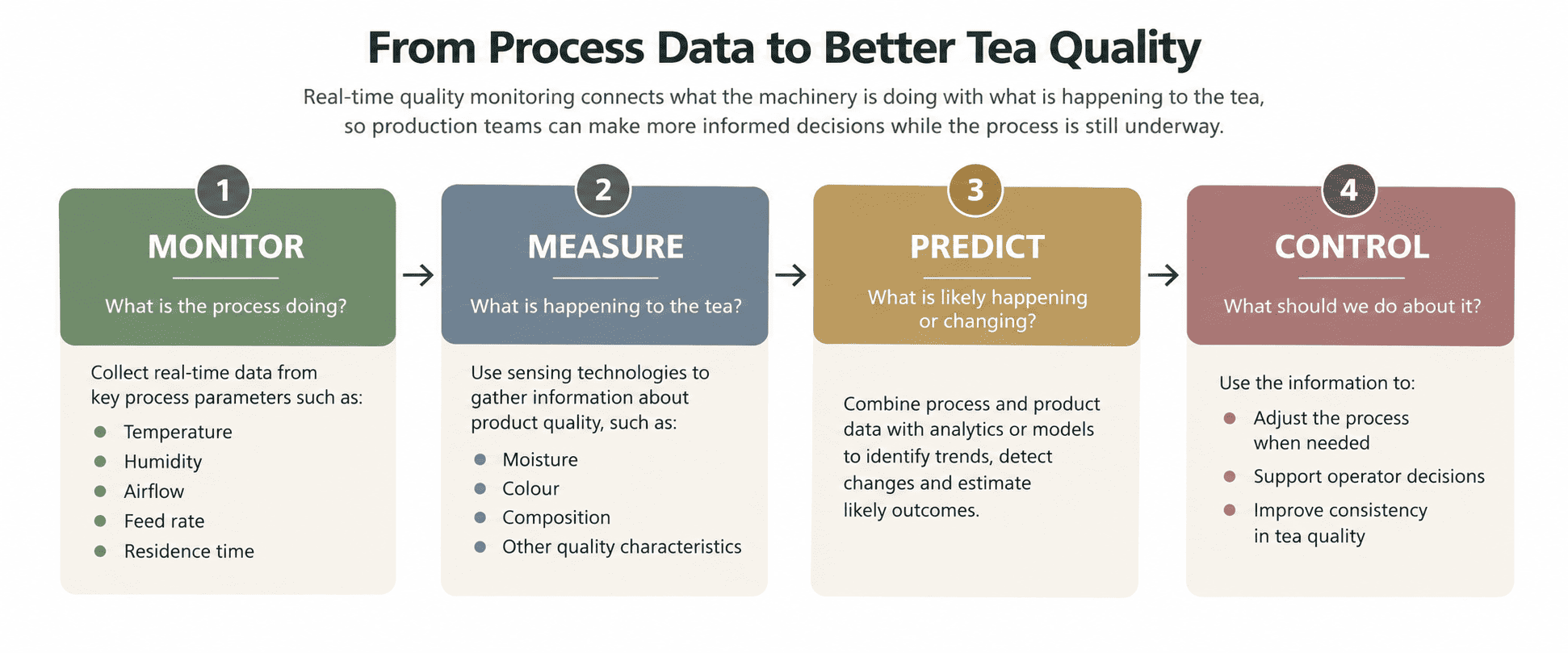
A temperature sensor, for example, can tell a dryer that its operating temperature is 120°C. That is process monitoring. A sensor or analytical system estimating the moisture content of the tea moving through the dryer provides information about the product. A predictive model can then estimate where that moisture level is heading. If the system automatically adjusts operating conditions in response, it becomes process control.
This distinction matters because having more data does not automatically mean having better quality control. The real value comes from collecting information that is relevant to the product, interpreting it correctly, and using it to support better processing decisions.
From Machine Data to Tea Data
Tea factories already monitor many conditions during processing, temperature, humidity, airflow, feed rate, and residence time, for example. This information helps production teams understand whether the machinery and process are operating as expected.
But knowing that the equipment is operating correctly does not always tell you how the tea itself is developing.
Two batches can pass through similar processing conditions and still show differences in moisture, colour, chemical composition, or other quality characteristics. This is why the next step in data-driven tea manufacturing is to look beyond machine data and capture more information about the product itself.
Technologies such as near-infrared sensing and computer vision are being researched for this purpose. Depending on the application, they can help estimate characteristics such as moisture, composition, or visual changes while the tea is still being processed. Research has also explored combining different types of sensor data to improve these predictions.
The idea is relatively simple:
Machine data tells you what the process is doing.
Product data tells you what is happening to the tea.
Bringing these two together gives manufacturers a more complete picture of the process and creates the possibility of identifying quality changes before the batch reaches the end of the production line.
Where Can Real-Time Quality Monitoring Help?
The value of real-time quality monitoring becomes clearer when we look at the questions a tea factory needs to answer during production.
Is the tea developing as expected? Has a process reached the required stage? Is something beginning to move outside the desired range?
Depending on the processing stage, different types of data can help answer these questions.
Withering
During withering, factories already monitor factors such as temperature, relative humidity, airflow, bed thickness, and processing time. Product-focused sensing could add another layer by helping estimate changes in the leaf itself, such as moisture or other quality-related characteristics.
This could help production teams understand not only whether the withering equipment is operating correctly, but also whether the leaf is progressing as expected.
Fermentation
Fermentation is particularly dependent on how the tea develops over time. Traditionally, operators rely heavily on process conditions, timing, appearance, and experience when deciding whether the desired stage has been reached.
Research has explored computer vision and electronic-nose technologies as ways of capturing visual and aroma-related changes during fermentation. These approaches could eventually provide additional information alongside operator assessment rather than relying on a single indicator.
Drying
Drying presents another opportunity because moisture is one of the most important characteristics to control before tea leaves the production line.
Instead of relying only on final sampling, product-focused sensing could potentially help estimate moisture changes during drying. This information could then be considered alongside dryer temperature, feed rate, airflow, and residence time.
The result is a more complete view of whether the dryer is producing the intended outcome, not simply whether the dryer itself is running within its operating parameters.
The bigger opportunity is not necessarily one technology for every stage. Different processing stages may require different measurements, while some characteristics may be estimated rather than directly measured.
For a tea factory, the practical goal is therefore not to collect every possible piece of data. It is to identify which information can help answer an important production question and make that information available early enough to act on it.
One Sensor Is Rarely the Whole Answer
Real-time quality monitoring does not necessarily mean finding one sensor that can tell a factory everything about its tea. Different measurements provide different pieces of information.
For example, temperature and humidity can describe the conditions around the tea, while moisture measurement can provide information about the product itself. Computer vision can capture visible changes, while other sensing methods may provide information that cannot be identified from appearance alone.
This is why recent research is increasingly looking at combining different types of data rather than depending on a single measurement. Studies combining NIRS with computer vision, for example, have explored whether the two can provide a better picture of tea quality than either source alone.
For a tea factory, the principle is fairly straightforward. One measurement can tell you what is happening in one part of the process. Multiple relevant measurements can help explain why it is happening.
However, this does not mean that every factory needs to install multiple sensors at every processing stage. The more useful approach is to first identify what needs to be known, and then determine which measurements can provide that information reliably.
That keeps data collection connected to an actual production decision rather than turning monitoring into data collection for its own sake.
Measurement Is Not the Same as Control
Having more information does not automatically improve the process.
A tea factory may have continuous data on temperature, humidity, moisture, or other quality indicators, but the real value comes from what the factory does with that information.
A useful way to think about the progression is: Measure → Understand → Decide → Control.
First, the system collects information about the process or the tea. Then, that information needs to be interpreted in relation to the desired process conditions or quality target. If a significant change is detected, the production team or an automated system can decide whether an adjustment is required.
For example, if drying data shows that the tea is not reaching the expected moisture condition, is it important to ask what is causing the difference and what should be changed?
The answer could involve feed rate, drying temperature, airflow, residence time, or another part of the process.
This is where real-time quality information can become more valuable than end-of-batch testing. Instead of discovering a problem after the tea has already completed processing, manufacturers can potentially identify changes while there is still an opportunity to respond.
However, not every measurement needs to trigger automatic action. In many cases, the role of real-time data may simply be to give operators earlier and clearer information for making a decision.
In the end, real-time monitoring is about making better decisions sooner and not necessarily removing people from the decision-making process.
What Could a Data-Driven Tea Factory Look Like?
The move toward data-driven manufacturing does not mean that a tea factory suddenly needs to become completely automated.
In practice, it can happen gradually. A factory may begin by collecting reliable information from individual processing stages. That information can then be brought together so production teams have a clearer view of what is happening across the line.
For example, a connected drying system could bring together information such as:
- Dryer temperature
- Feed rate
- Residence time
- Product moisture
- Production output
- Alarms or process interruptions
The same principle can be applied to other stages. T&I Global’s automation solutions, for example, already focus on collecting and using process information. CFM Automation monitors parameters such as temperature, relative humidity, bed thickness, residence time, and belt speed, while Dryer Automation provides monitoring and control of dryer conditions and feeding. Smart Discharge can also record production and batch-related information.
The next step is connecting this process information with information about the tea itself. That could eventually allow a production team to see something closer to:
- What is the machine doing?
- What is happening to the tea?
- Is the process moving toward the desired result?
- Does anything need to change?
This is where data-driven manufacturing becomes practical. The objective is not simply to have more screens, sensors, or software in the factory. It is to turn process data into information that can support timely production decisions.
What Should Tea Manufacturers Consider Before Implementing Real-Time Quality Monitoring?
The technology is developing quickly, but adopting real-time quality monitoring should begin with the process problem, not the technology itself.
Before introducing new sensors or analytical systems, a tea factory should consider a few practical questions:
1. What do you need to know?
Start with a specific production question. Is the concern inconsistent withering? Unstable fermentation? Variation in final moisture? Or difficulty identifying where quality changes are occurring?
The answer determines what information is actually useful.
2. Where should the information be collected?
Not every processing stage needs the same level of monitoring. A factory may benefit more from detailed monitoring at a particular stage than from collecting large amounts of data across the entire plant.
3. Can the data be trusted?
Measurements are only useful when they are consistent and properly interpreted. Calibration, operating conditions, and the quality of the underlying data all matter when using sensing technologies to estimate product characteristics.
4. What will happen after a change is detected?
This is perhaps the most important question. If a system identifies that something is moving outside the desired range, the factory needs a defined response. Otherwise, the system may simply produce another notification without improving the process.
5. Can the information connect with existing systems?
Real-time quality monitoring becomes more useful when product information can be considered alongside existing machine and production data.
The long-term objective is therefore not to create a separate “quality monitoring system” sitting alongside the factory. It is to gradually build a connected process where equipment data, production data, and product-quality information can support the same decision-making process.
Building a More Connected Tea Processing Future
Real-time quality monitoring is giving tea manufacturers new ways to understand what is happening during processing, not just after a batch is complete. By bringing together machine data, product information, and predictive tools, factories can identify changes earlier and make more informed decisions while the process is still underway.
The technology is still developing, but the direction is clear. At T&I Global, automation solutions already bring together process monitoring and machine control across stages such as withering, CFM processing, and drying. The next step is connecting this process information with better insights into the tea itself.
Ultimately, data-driven tea manufacturing is not about collecting more data. It is about having the right information at the right time, and using it to achieve greater process visibility, consistency, and control.