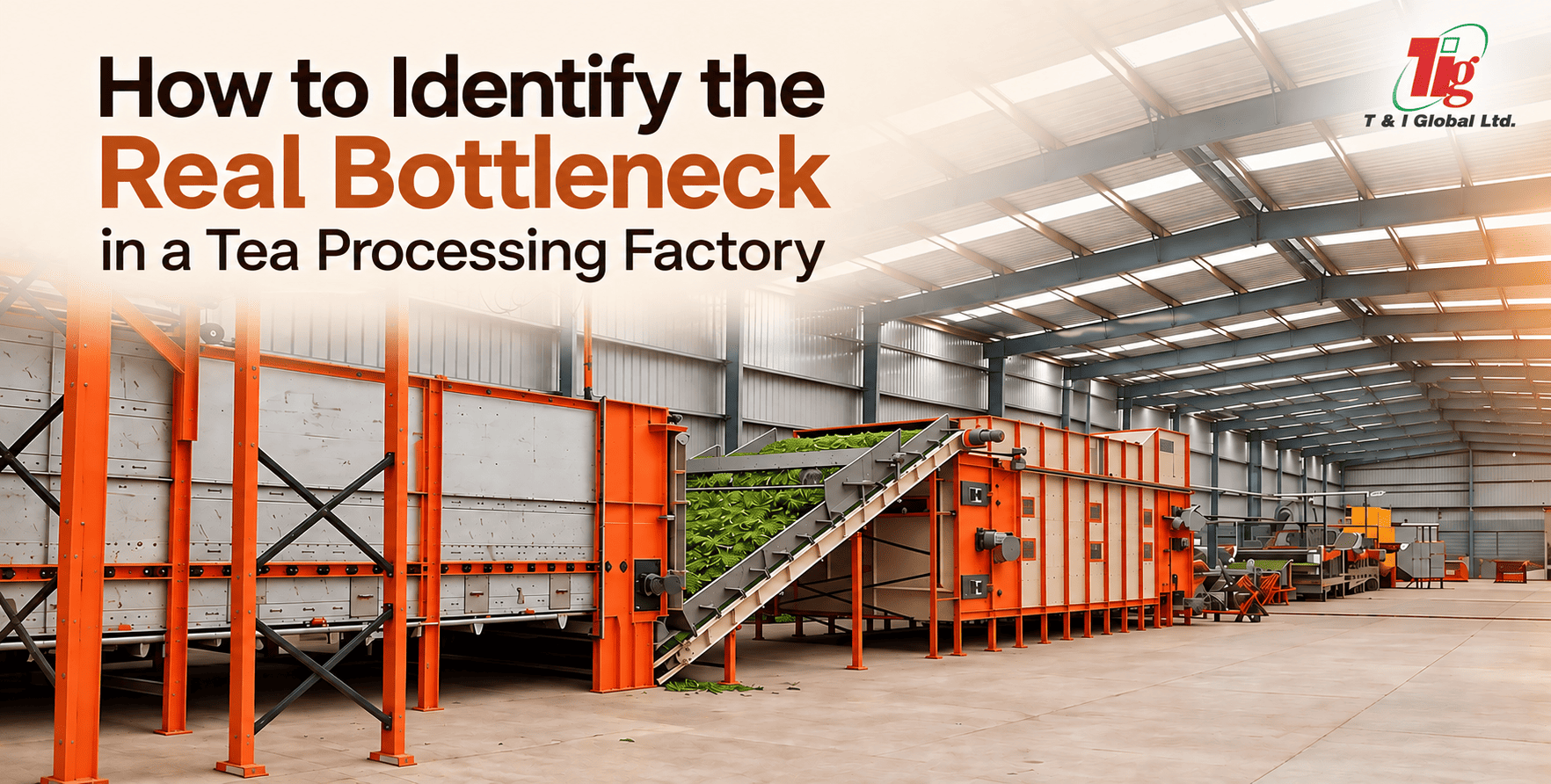
A tea factory can have modern machinery, experienced operators, and a well-established production line, and still struggle to achieve its expected output.
When production falls short, the first instinct is often to look for the machine that needs to be upgraded or replaced. But the real constraint may not be where it appears. A shortage of withering capacity, inconsistent feed conditions, delays between processing stages, frequent downtime, or limited drying capacity can all affect how much tea a factory can produce.
The challenge is that a tea processing line works as a connected system. Increasing the capacity of one section does not automatically increase the factory’s overall output.
Before investing in new equipment, factory owners and production teams need to answer a more important question: Where is the real bottleneck, and what is causing it?
This guide explains how to identify capacity constraints across a tea processing factory, distinguish symptoms from underlying problems, and make more informed decisions about process improvements, automation, retrofits, or expansion.
What Is a Bottleneck in Tea Processing?
For a tea factory, a bottleneck is more than a machine operating slowly. It is a constraint that limits the output of the overall processing line.
Think of the factory as a connected chain. Green leaf moves through withering, maceration or CTC processing, fermentation, drying and, eventually, sorting, grading and packing. Each stage depends on the previous one and must be able to handle the flow of material coming into it.
If one section cannot keep pace, the effects can spread across the factory. Material may accumulate before that stage, while other equipment remains underutilised.
Rated capacity is not the same as actual capacity
One reason bottlenecks are often misunderstood is that a machine’s rated capacity does not necessarily represent what it can produce consistently in everyday factory conditions.
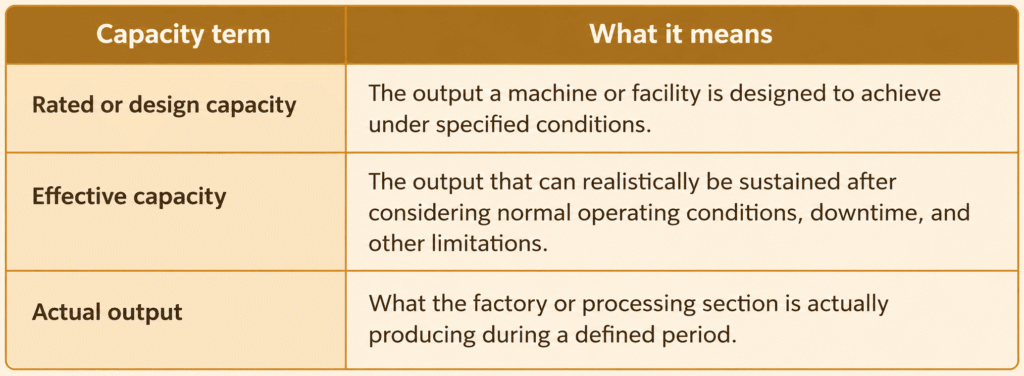
For example, a dryer may have a stated capacity under particular feed-moisture and operating conditions. Its actual output may differ when the incoming tea, operating schedule, or supporting systems change. This is why comparing a machine’s brochure capacity with a factory’s actual production is not enough to diagnose a problem.
The bottleneck may not be where you expect
A tea-factory capacity study published in the Future Business Journal examined constraints across processing firms and identified equipment, people, raw materials and management policies as possible constraints. It also emphasised that improving one bottleneck does not necessarily improve the overall system if another constraint remains.
In practical terms, a factory may appear to have a dryer problem, when the underlying issue is inconsistent feed from fermentation. Or it may seem to need a larger CTC machine, when the real limitation is insufficient withering capacity or a downstream stage that cannot absorb additional output.
The real question is not “Which machine is slowest?” but “Which constraint is limiting the factory’s ability to produce more finished tea?” That distinction is the foundation of effective capacity planning and modernisation.
Why Tea Factory Bottlenecks Are Often Misdiagnosed
A production problem rarely announces its true cause.
When output falls below target, the most visible issue often gets the most attention: a machine appears too slow, a section seems overloaded, or production stops at a particular point. But what looks like an equipment problem may actually be caused by inconsistent material flow, downtime, limited supporting utilities, or a capacity mismatch elsewhere in the line.
The problem with looking at one machine in isolation
Tea processing is a connected sequence. The output of one stage becomes the input for the next, so a disruption in one section can affect several others.
For example, if a CTC section is not receiving enough properly conditioned leaf, its available capacity may not be the real issue. Similarly, if fermented tea is accumulating before drying, the dryer may be the constraint, or the problem may involve feed conditions, thermal performance, or interruptions in the drying system.
Three questions to ask before blaming a machine
1. Is the section genuinely operating at its effective limit?
Or is its output being reduced by stoppages, inconsistent feeding, maintenance, or operating conditions?
2. Is the problem upstream or downstream?
A section may be waiting for material, or producing faster than the next stage can handle.
3. Would upgrading this section increase finished-tea output?
If another constraint remains, adding capacity in one area may simply shift the bottleneck elsewhere.
The key is to diagnose the cause before choosing the solution. A factory may need better process coordination, maintenance, automation, additional capacity, or a combination of these, but that decision should follow the evidence.
Where Bottlenecks Can Occur in a Tea Processing Factory
A tea processing factory is a sequence of connected operations. In a typical Orthodox tea manufacturing line, green leaf moves through withering, rolling, fermentation, drying, and finally grading and sorting. Each stage has its own operating requirements, and each must be able to support the flow of material around it.
A bottleneck can occur at any point where the required flow exceeds the stage’s effective capacity.
What to examine at each stage
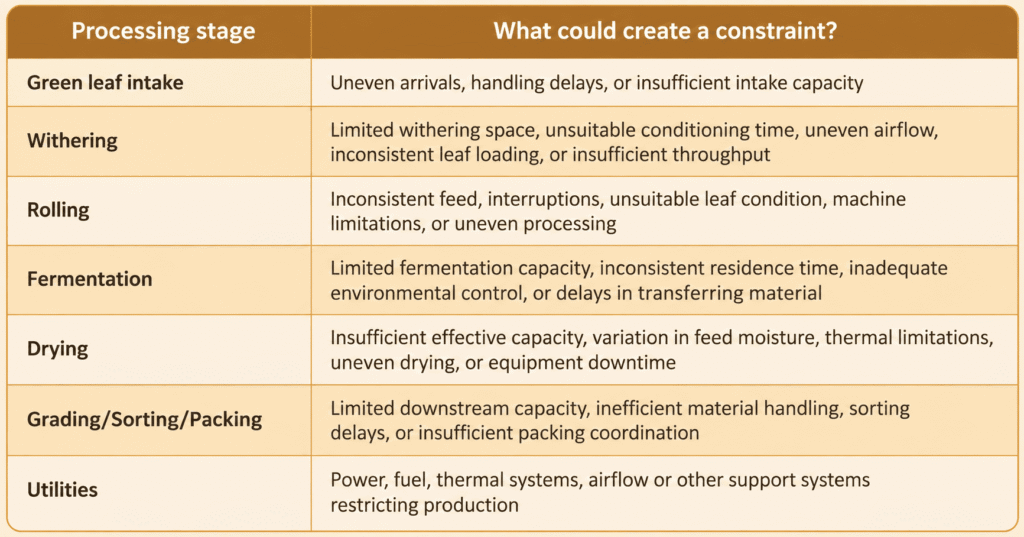
The important takeaway
A factory may have enough capacity in one section but still struggle to increase finished-tea output because another stage cannot keep up.
For example, adding more CTC capacity may not solve a problem if withering cannot supply enough conditioned leaf. Similarly, increasing dryer capacity may have limited impact if fermentation or downstream sorting remains the constraint.
The first step is therefore to map the complete line and identify where material is waiting, accumulating, or falling behind, not simply where a machine appears busy.
A Practical 5-Step Method to Find the Real Bottleneck
Instead of asking factory teams to guess which machine is underperforming, the better approach is to follow the production flow, compare actual performance, and investigate where capacity is being lost.
Step 1: Track the complete process flow
Start by mapping how tea moves through the factory, from green leaf intake to finished tea. Record where material accumulates, where sections wait for feed, and where production slows down.
A useful starting question is: Where does tea consistently wait longer than it should? A queue before a section may indicate a capacity constraint. But an empty section can also be a clue. It may be waiting for material from an upstream stage.
The goal is to understand the relationship between stages rather than assess each machine in isolation.
Step 2: Record actual capacity, not just rated capacity
Next, compare the stated capacity of each section with what it actually processes during normal operation.
For example, a dryer may be designed for a particular feed rate under specified moisture and operating conditions. If the factory is consistently achieving less, the next question is whether the limitation comes from the equipment itself, the incoming material, operating conditions, or downtime.
Measure what the section can sustain, not just what it can theoretically achieve.
Step 3: Analyse waiting time and downtime
A machine may appear to be a bottleneck simply because it is frequently stopped or underfed.
Review:
- Unplanned stoppages
- Maintenance-related downtime
- Changeovers and cleaning
- Material waiting time
- Manual handling delays
- Utility interruptions
- Time spent adjusting operating conditions
This helps separate a capacity problem from an availability or operational problem. The solution may be maintenance, process improvement, or better coordination rather than immediate equipment replacement.
Step 4: Check material and process conditions
Tea processing capacity is influenced by the condition of the material entering each stage.
Withering, for instance, affects the leaf’s suitability for subsequent processing. In drying, feed moisture and operating conditions influence the load placed on the dryer. In fermentation, process conditions must be maintained appropriately for the intended tea quality.
Ask: Is the equipment struggling, or is it receiving material under conditions different from those used to define its expected capacity?
This distinction is particularly important when evaluating whether a machine upgrade is actually necessary.
Step 5: Evaluate the constraint before investing
Once the likely bottleneck is identified, consider what intervention would address it. Depending on the cause, the right response may involve:
- Improving process coordination
- Reducing avoidable downtime
- Optimising operating conditions
- Balancing capacities between sections
- Introducing appropriate automation
- Retrofitting existing equipment
- Adding capacity where the constraint is structural
- Redesigning part of the processing line
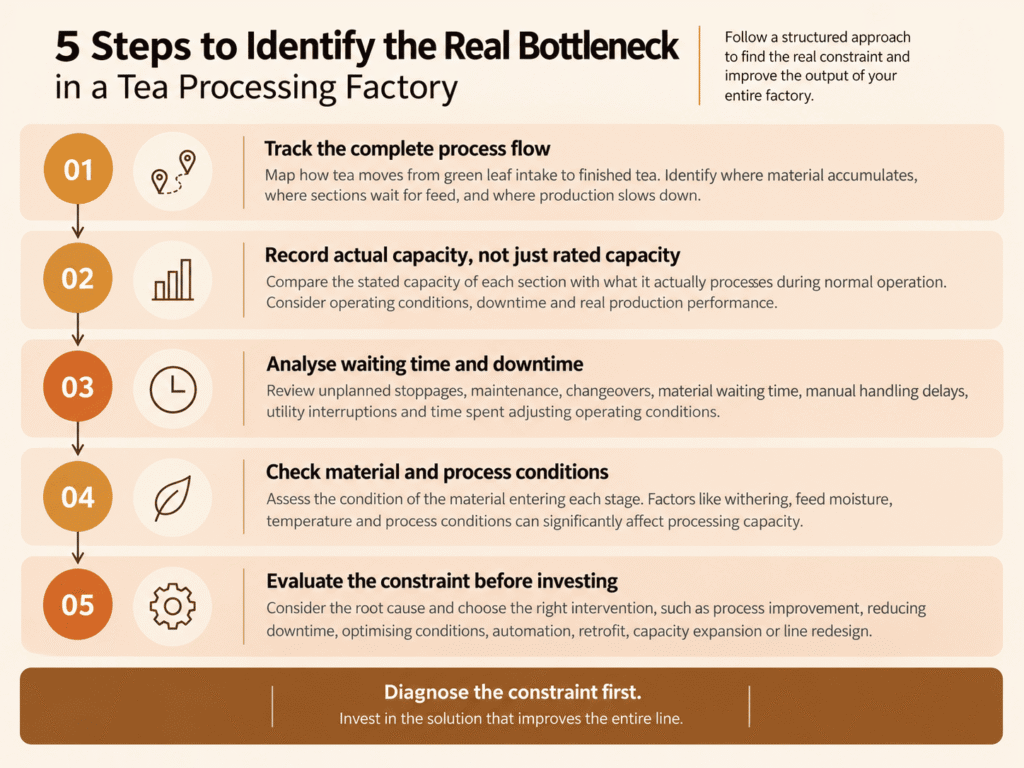
The objective is not simply to make one machine faster. It is to improve the output of the complete factory.
Bottleneck Diagnosis Checklist
Before deciding to purchase new machinery or expand an existing processing section, production teams can use the following checklist to validate whether the identified constraint is genuine.
Tea Factory Bottleneck Checklist
✔ Have we mapped the complete processing line from green leaf intake to grading and sorting?
✔ Where is tea consistently waiting, accumulating, or being held back?
✔ Are we comparing actual output with effective capacity rather than only rated capacity?
✔ Have we reviewed equipment downtime and recurring stoppages?
✔ Are maintenance, cleaning and changeover periods affecting throughput?
✔ Is the section receiving a consistent quantity and quality of material?
✔Are withering, fermentation and drying conditions being maintained within the required operating range?
✔ Are power, fuel, airflow, heating or other utilities restricting production?
✔ Is the section genuinely overloaded, or is it losing capacity because of operational inefficiencies?
✔ If we upgrade this section, will the overall finished-tea output increase?
✔ Could process coordination, automation, maintenance, or a retrofit solve the issue more effectively?
✔Have we checked whether the bottleneck will simply shift to another stage after the proposed improvement?
The purpose of this checklist is not to delay investment. It is to ensure that investment is directed towards the constraint that has the greatest effect on factory-wide performance.
Choosing the Right Intervention
Identifying a bottleneck is only the first part of the process. The next step is deciding how to address it without creating unnecessary expenditure or shifting the constraint to another part of the factory.
The appropriate intervention depends on the nature of the problem.
When process improvements may be enough
If the bottleneck is caused by avoidable inefficiencies, a machinery upgrade may not be the immediate answer. Improvements could include:
- Better coordination between processing sections
- More consistent material feeding
- Improved production scheduling
- Preventive maintenance planning
- Reduced cleaning or changeover time
- Improved operator training
- Better monitoring of process conditions
- Faster material transfer between stages
These measures can help recover lost capacity from equipment that is already installed.
When automation can improve throughput
Automation can be useful when the constraint is linked to inconsistent control, manual intervention, or difficulty maintaining process conditions.
For example, monitoring and control systems can help production teams track variables such as temperature, relative humidity, residence time, feed rate, belt speed, etc.
T&I Global’s automation solutions for tea processing include systems designed to monitor and control process parameters through features such as HMI-based operation, variable-frequency drives, and automated feed or temperature control.
However, automation should be introduced to address a clearly identified operational need. Automating a non-critical section will not necessarily improve factory-wide output if the actual constraint exists elsewhere.
When a retrofit or capacity expansion is justified
A retrofit or new machine may be appropriate when the data shows that a section is consistently operating at its effective limit, even after operational inefficiencies have been addressed.
The best investment is not necessarily the largest machine or the newest technology. It is the intervention that removes the constraint with the greatest effect on the complete processing system.
The goal is not to make one section faster in isolation. It is to create a
better-balanced tea processing line that can produce more consistently and efficiently.
Make the Right Decision for Your Tea Processing Line
A bottleneck is not always a sign that a factory needs a completely new processing line. In many cases, the first improvement may come from better coordination, maintenance, process control, or more effective use of existing equipment.
However, when a section is consistently operating at its practical limit, a retrofit, automation upgrade, or capacity expansion may be necessary. The important thing is to base that decision on the factory’s actual operating conditions and not only on rated machine capacity or the most visible production issue.
At T&I Global, tea-processing solutions are developed with an understanding of how individual stages work together across a complete production line. From Orthodox and green tea machinery to CTC processing systems, drying solutions and automation, the focus is on helping tea manufacturers improve process control, operational efficiency and long-term production performance.
Whether the requirement is to optimise an existing setup, address a specific capacity constraint, or plan a larger modernisation project, the starting point should always be the same: understand the bottleneck first, then choose the solution that improves the performance of the entire tea processing line.
Frequently Asked Questions (FAQs)
1. What is a bottleneck in a tea processing factory?
A bottleneck is a stage or constraint that limits the output of the entire tea processing line. It may occur due to insufficient equipment capacity, inconsistent material flow, equipment downtime, process delays, labour limitations, or restricted utilities.
2. How can I identify the real bottleneck in my tea factory?
Start by mapping the complete processing line and observing where tea consistently accumulates, waits, or falls behind. Then compare actual output with effective capacity, review downtime, check material and process conditions, and determine whether the issue is operational or structural.
3. Does increasing the capacity of one machine improve overall tea production?
Not necessarily. If another stage has a lower effective capacity, upgrading one machine may only shift the bottleneck elsewhere. Any capacity expansion should therefore consider upstream supply, downstream handling, utilities, and the effect on finished-tea output.
4. Can automation help reduce bottlenecks in tea processing?
Yes. Automation can help improve process monitoring, feed control, residence-time management, temperature regulation, and equipment coordination. However, automation is most effective when it is selected to address a clearly identified constraint rather than introduced without a specific operational objective.