Nilgiris & Anamalai Regions, South India
WIZARD Continuous Withering System, MATRIX Continuous Fermentation Machinery (CFM), KAIZEN Super CTC, VIBRANT Dual Stage Vibro Fluid Bed Dryer
Tea manufacturers across South India’s Nilgiris and Anamalai regions operate under challenging climatic conditions. During the monsoon season, high humidity and prolonged rainfall make traditional open-air withering highly unpredictable. Variations in moisture removal often result in uneven withering, bacterial deterioration of green leaves, and significant crop losses.
At the same time, factories face increasing pressure from rising fuel costs, labour shortages, and the need to produce consistent, export-quality tea. Conventional direct-fired drying systems consume substantial amounts of thermal energy, while manual processing methods introduce variations that affect product quality and operational efficiency.
To remain competitive, manufacturers require an integrated industrial tea processing solution capable of delivering consistent quality while reducing energy consumption, manual intervention, and production losses.

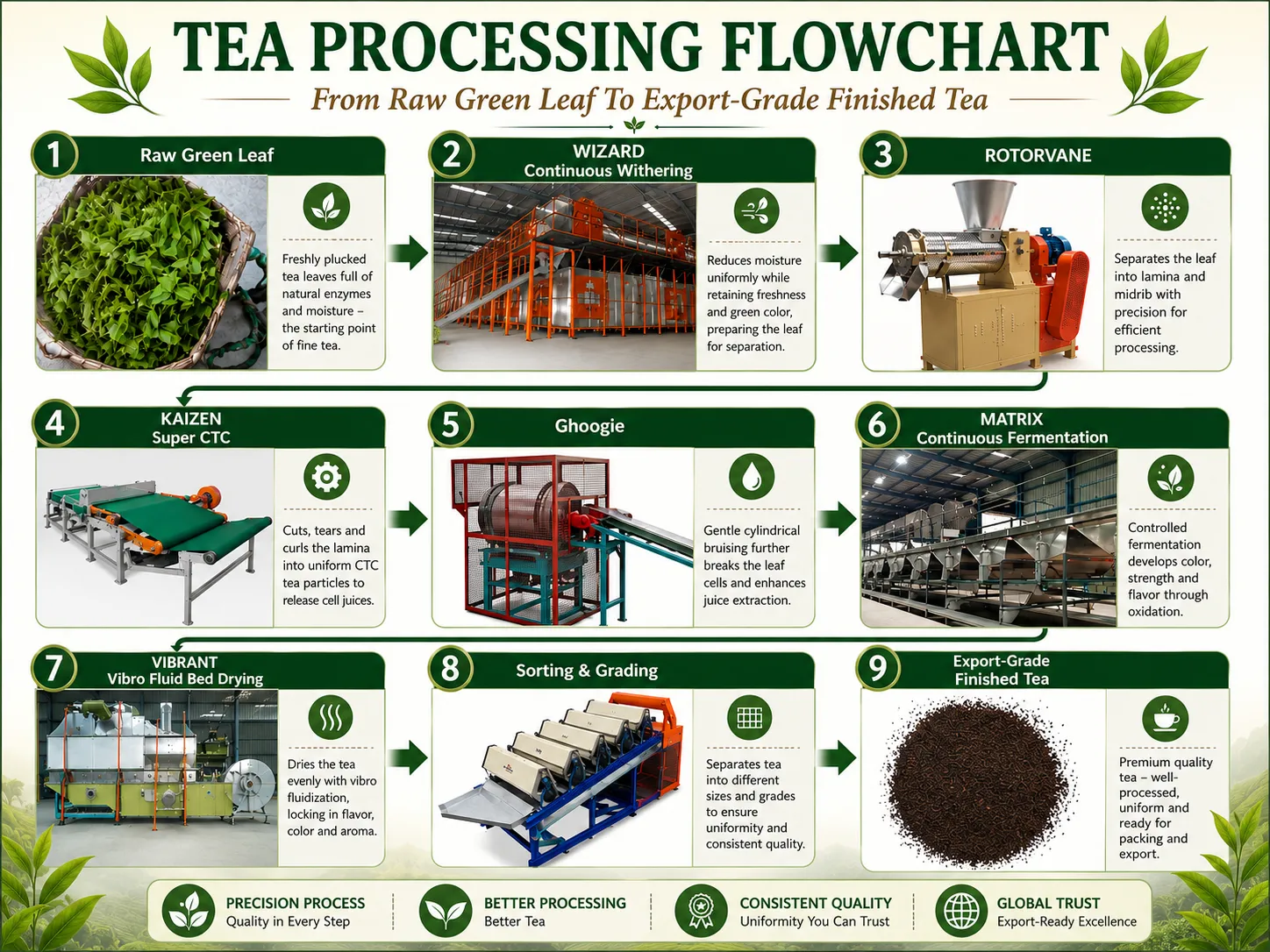
To address these operational challenges, manufacturers implemented a fully integrated automated tea manufacturing line engineered by T&I Global Limited (TIGL). The solution automated every critical stage of production, from withering and pre-conditioning to CTC manufacture, fermentation, and drying, creating a controlled and efficient processing environment with minimal human intervention throughout the production cycle.
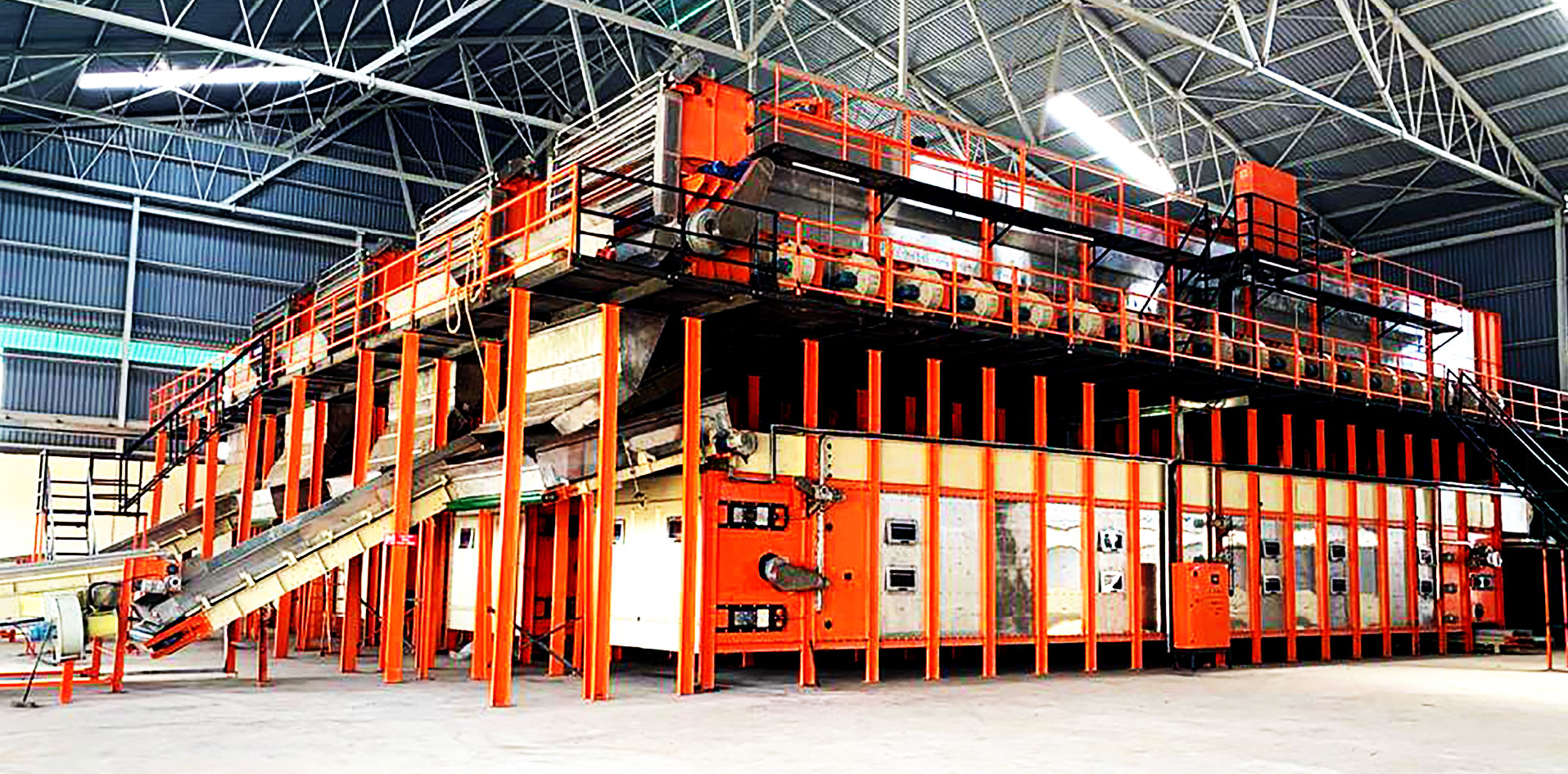
The WIZARD Continuous Physical and Chemical Withering System (CCW and CPW) replaced conventional weather-dependent withering methods with a controlled process that regulates airflow, temperature, and moisture extraction. By maintaining stable processing conditions throughout the year, the system minimizes the impact of seasonal climate variations while ensuring uniform physical and chemical withering. As a continuous process, it minimizes manual handling after green leaf unloading, significantly reducing the possibility of human contact and contamination during processing.
Following withering, the tea leaves pass through the ROTORVANE for controlled leaf conditioning and preparation before entering the KAIZEN Super CTC. This stage ensures uniform feeding and prepares the leaf for efficient crushing, tearing, and curling.
The KAIZEN Super CTC system standardized the crushing, tearing, and curling process to produce uniform tea granules with consistent particle size. Compared with conventional CTC machines, it offers operational advantages such as reduced spillage, lower vibration, and improved processing stability. Automated roller maintenance through the Smart Axis Automatic Chasing Machine further reduced maintenance time while improving machine availability.
After CTC manufacture, the processed tea passes through the Ghoogie before entering the MATRIX Continuous Fermentation Machinery (CFM). The MATRIX system uses slow-speed upturner blades to maintain consistent leaf bed thickness and promote uniform oxidation, replacing labour-intensive floor fermentation while improving process consistency across production batches.
The final drying stage utilized the VIBRANT Dual Stage Vibro Fluid Bed Dryer, where tea leaves are suspended on a controlled cushion of hot air for uniform drying. This fluidized drying process enhances heat transfer efficiency, reduces fuel consumption, and preserves the desired quality characteristics of the finished tea.
Following the drying process, the finished tea is sorted and graded based on particle size and quality characteristics. This ensures uniformity across different tea grades, enabling manufacturers to meet customer specifications and export quality standards.
The implementation of TIGL’s integrated automation solution delivered measurable improvements in productivity, energy efficiency, equipment availability, and product quality.
The transition from conventional processing methods to TIGL’s integrated tea processing machinery platform enabled tea manufacturers to modernize their operations while improving profitability and long-term competitiveness.
Greater process control reduced dependence on seasonal weather conditions, while improved energy efficiency and lower maintenance requirements helped reduce operating costs. At the same time, consistent product quality strengthened manufacturers’ ability to meet international buyer expectations and expand into export markets.
Backed by T&I Global’s in-house manufacturing expertise and DSIR-certified R&D facility in Coimbatore, these installations demonstrate how intelligent process automation enables tea factories to achieve higher productivity, greater operational efficiency, and sustainable long-term growth.
T & I GLOBAL Limited (TIGL).
+91-33-22833612
[email protected]